Combined pre and postnatal yoga certification vs two separate courses: which prepares you to teach both stages of pregnancy?
- Anandam Yoga
- Last Updated: October 27, 2026
Written by
M.A. Yoga and Yoga Therapy, Uttarakhand University · Co-Founder and Lead Teacher, Anandam Yoga School · Direct descendant of the Rishi Atri lineage
Reviewed by
Dr. Katharina Austermann, PhD, E-RYT 500
PhD in Nutrition and Food Science, University of Bonn (2023) · Co-Founder and Anatomy Faculty, Anandam Yoga School · Diploma in Ayurveda
Content updated: October 27, 2026 · Estimated reading time: 11 minutes
Quick Answer
A combined pre and postnatal yoga certification, completed as one program, is usually the stronger choice when you intend to teach both populations. The combined format connects the physiological changes of pregnancy, birth, and postpartum recovery, helping you understand how a third-trimester modification relates to a practice offered six weeks after birth. It can also reduce duplicated registration, travel, and time away from work while giving you one coherent certificate to explain to studios and insurers.
Separate courses can still make sense when you genuinely plan to work with only one population or cannot attend a combined program. Course acceptance is always determined by the individual studio, employer, insurer, or registration body.
Key Takeaways
- A combined 100-hour pre and postnatal program teaches prenatal and postpartum modifications together, showing how the body's needs change across pregnancy, birth, and recovery.
- Two standalone courses may create additional registration, travel, and time-away costs compared with one residential program.
- One integrated certificate can be easier to explain professionally, although every studio and insurer sets its own acceptance requirements.
- Anandam's 100-Hour Pre and Postnatal Yoga Teacher Training in Germany runs from November 20-29, 2026, as one continuous residential course.
- Props-based teaching practice and observed modifications help trainees turn anatomy and safety principles into practical teaching decisions.
| Decision | Combined pre and postnatal course | Separate standalone courses |
|---|---|---|
| Learning structure | Pregnancy, birth, and postpartum recovery are taught as one connected progression. | Each population is studied independently, sometimes with different providers or teaching approaches. |
| Continuity | Makes the transition from trimester-specific practice to postpartum recovery visible. | A gap can arise between what was taught prenatally and what is learned later about recovery. |
| Time and logistics | One application, one period away, and one learning environment. | May require two applications, schedules, journeys, and sets of course terms. |
| Credential presentation | One certificate clearly naming prenatal and postnatal study. | Two certificates may need additional explanation of hours, scope, and provider standards. |
| Main advantage | Integrated understanding across the complete transition into motherhood. | Flexibility to study one population first or select different specialist teachers. |
| Main risk | Postnatal content may still be too brief unless the curriculum is examined carefully. | Different assumptions, terminology, and methods may not connect cleanly. |
Why This Decision Matters More Than It Looks
If you search for pre and postnatal yoga certification, you will find two different routes. One is a single combined program, often 80 to 150 hours, that treats pregnancy and the postpartum period as one subject with distinct but connected phases. The other is a patchwork: a shorter prenatal-only module from one provider followed months or years later by a postnatal-only course, sometimes with a different teaching lineage and different assumptions about what a student's body can do.
On paper, the separate route appears flexible. You can begin with the prenatal component, experience the subject, and decide about postnatal study later. In practice, it can become more complicated for three reasons.
1. The Physiology Does Not Split at the Birth Date
Diastasis recti, pelvic floor changes, postural adaptation, and the gradual return of core stability do not suddenly begin on the day a baby is born. These changes develop during pregnancy and continue through recovery. A teacher trained only in prenatal modifications may have a gap when the same student returns to class postpartum.
A combined curriculum can close that gap deliberately by teaching the handoff between these stages instead of treating pregnancy and recovery as unrelated subjects.
2. Separate Training Can Duplicate Costs and Logistics
Two standalone modules can involve separate registration fees, travel, accommodation, time away from work, and study materials. Whether a combined course costs less depends on the providers and formats being compared, so calculate the complete cost rather than comparing tuition alone.
Our guide to 50-hour vs 100-hour yoga teacher training explains why the number on a certificate should be considered alongside curriculum depth, practice teaching, assessment, and professional scope.
3. One Coherent Scope Is Easier to Explain
A studio, employer, or insurer may ask what you have been trained to teach. One certificate that clearly covers prenatal and postnatal practice can be easier to present than two certificates with different hour counts, providers, and teaching philosophies. This does not guarantee acceptance: the decision still belongs to the studio, employer, insurer, or registration body.
What a Genuinely Combined Program Should Cover
Look beyond the course title and examine how much attention is actually given to the postnatal period. Some courses are advertised as pre and postnatal but concentrate mainly on pregnancy while treating postpartum recovery as a short final topic.
The period after childbirth can be one of the most physically and emotionally vulnerable stages in the transition into motherhood. The body is recovering from pregnancy and birth, hormonal changes are significant, and new mothers are adapting to different physical, emotional, and practical demands. Pelvic floor recovery, abdominal rehabilitation, postural changes, sleep deprivation, and emotional well-being all require thoughtful consideration.
A genuinely combined program should therefore give postnatal recovery substantial depth alongside prenatal yoga. It should explain not only how the body changes during pregnancy, but also how those changes influence birth and postpartum recovery.
Curriculum Questions to Check
- Are all trimesters covered, including practical modifications and contraindications?
- Does the program address the fourth trimester and gradual return to activity?
- Are pelvic floor, abdominal wall, posture, breathing, and emotional changes explained together?
- Will you practice planning and teaching both prenatal and postnatal classes?
- Are props, consent, observation, referral, and professional boundaries taught practically?
- Who teaches anatomy and the population-specific safety content?
Supporting women through pregnancy matters, but supporting them through recovery and the transition into motherhood deserves equal care. A comprehensive training recognizes that the learning journey does not end with childbirth.
Anandam's 100-Hour Pre and Postnatal Yoga Teacher Training in Germany follows one cohort through pregnancy and postpartum content as a connected course. The residential intake runs from November 20-29, 2026, in Heimbach, Germany.
Review the November Residential Course
Compare the full curriculum, admission requirement, room options, fees, and included accommodation before deciding whether the combined format fits your teaching path.
From the Teaching Floor: Why Modifications Cannot Be an Afterthought
Yogi Sandeep Atri, Anandam's lead teacher and an E-RYT 500 with an M.A. in Yoga and Yoga Therapy from Uttarakhand University, describes how modifications are treated as a continuing teaching practice:
"We offer modifications, variations and alternatives for every posture, using props like blocks, belts, bolsters, cushions, blankets, chairs and walls. It is a continuing process. The more students you teach, the more you learn, because every body is different."
That last point, every body is different, is central to prenatal and postnatal teaching. A person at week 30 of pregnancy and the same person six weeks postpartum should not be treated as two unrelated case studies. The teacher needs to understand what changed, what may still be recovering, which practices are appropriate, and when a question belongs with a healthcare provider.
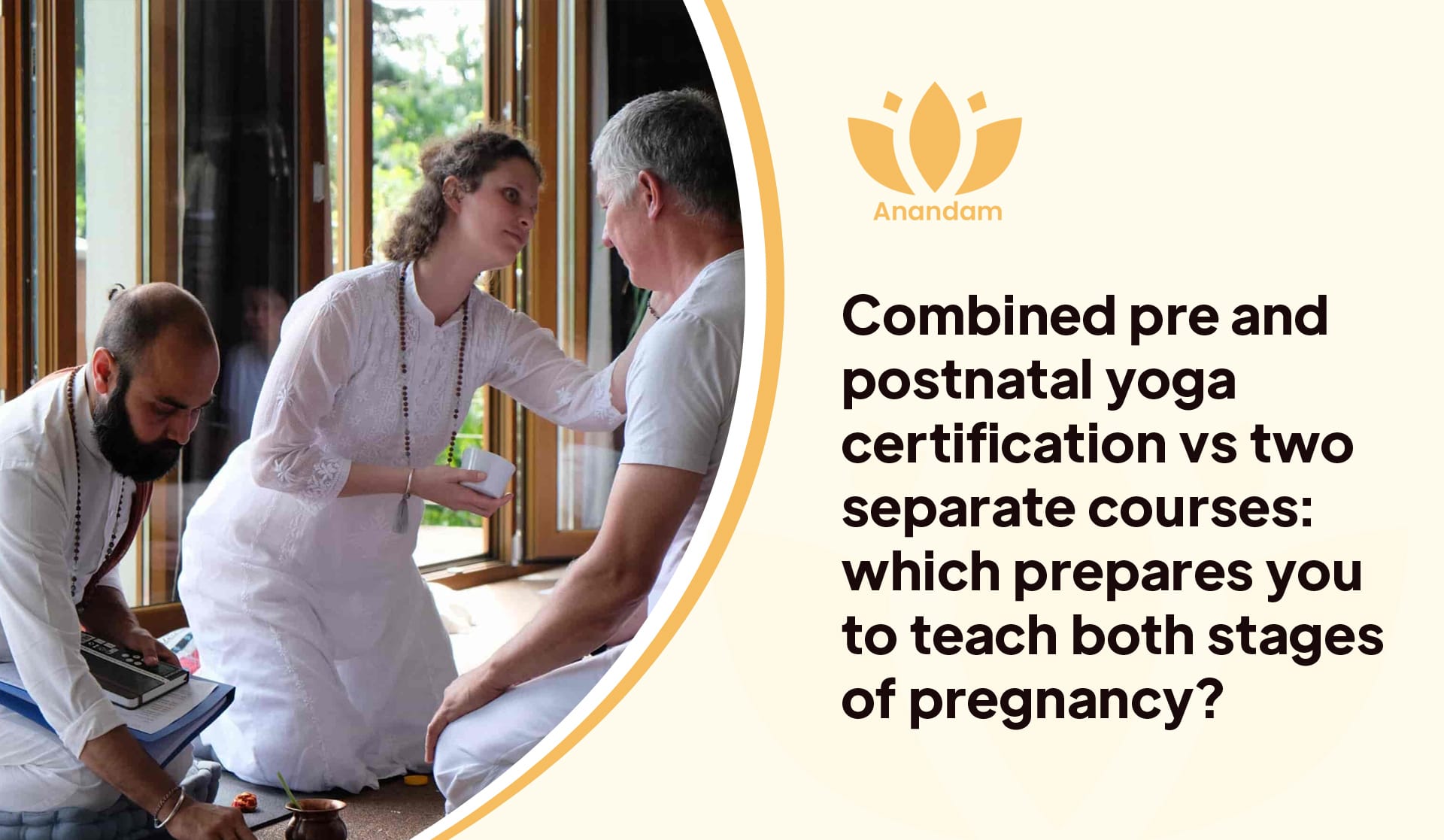
In Anandam's residential training model, trainees begin practicing teaching in small groups early in the course. This allows knowledge about anatomy, props, cueing, and modifications to be applied while feedback is still available. You can read more about the learning environment in our guide to residential prenatal yoga training in Germany.
A Note on What This Certification Does Not Cover
However the course is packaged, a 100-hour pre and postnatal certificate is a yoga teaching qualification, not a healthcare license. It does not replace medical clearance or authorize a teacher to diagnose, treat, or manage a high-risk pregnancy or complicated postpartum recovery.
A responsible program teaches the boundary between yoga education and clinical care, including when to pause, adapt, request medical clearance, or refer a student back to her healthcare provider.
Making the Call
If you already know that you want to teach both pregnant and postpartum students, a combined program is usually the more coherent route. It allows you to study the body across one continuous transition, practice both types of teaching within the same educational framework, and describe the scope of your certificate clearly.
The exception may be a teacher who genuinely plans to work with only one population or whose schedule makes a combined residential course impossible. Even then, understanding postpartum recovery can strengthen prenatal teaching because it provides a clearer view of what comes next.
For most teachers planning a long-term specialty in this area, the strongest question is not simply "How many certificates will I receive?" It is: "Will this course prepare me to support the complete transition responsibly, while recognizing where yoga teaching must stop?"
Frequently Asked Questions
Is a combined pre and postnatal yoga certification better than separate courses?
A combined program is usually the stronger choice if you intend to teach both pregnant and postpartum students. It connects pregnancy, birth, recovery, and the gradual return to practice in one curriculum. Separate courses can still make sense when you genuinely plan to work with only one population or cannot attend a combined course.
Do I need a 200-hour qualification for Anandam's 100-hour course?
Yes. Anandam's current admission requirement for the November 20-29, 2026 Pre and Postnatal Yoga Teacher Training is a completed 200-hour yoga teacher training. Contact the school before booking if you are unsure whether your existing qualification meets the requirement.
How much does Anandam's 100-hour pre and postnatal training cost?
The November 20-29, 2026 residential course costs EUR 2,700 per person in a shared twin room or EUR 2,900 in a private double room. The published packages include nine nights of accommodation, breakfast, lunch, dinner, study materials, certification, and Wi-Fi access.
Does a 100-hour pre and postnatal certificate automatically make me an RPYT?
No. Anandam's course is listed as Yoga Alliance YACEP continuing education. Yoga Alliance's separate RPYT pathway currently requires an RYT credential, an eligible 85-hour training with a Registered Prenatal Yoga School, and 30 prenatal teaching hours completed after that training. Verify the current pathway directly with Yoga Alliance before enrolling for a specific credential.
What should a combined prenatal and postnatal yoga course cover?
A strong combined course should cover physiological and emotional changes during pregnancy and postpartum, trimester-specific practice, pelvic floor and abdominal recovery, contraindications, props, class planning, practical teaching, professional boundaries, and appropriate referral. Postnatal recovery should receive substantial attention rather than appearing as a brief final module.
Can a prenatal and postnatal yoga teacher give medical advice?
No. A yoga teaching certificate does not authorize medical diagnosis, treatment, or management of high-risk pregnancy or complicated postpartum recovery. Teachers should remain within yoga's professional scope, request appropriate medical clearance, and refer students to qualified healthcare providers when needed.
Why does practical teaching matter in pre and postnatal yoga training?
Practical teaching lets trainees apply anatomy, safety principles, props, cueing, and modifications to different bodies while qualified teachers can observe and give feedback. Knowing a modification in theory is not the same as selecting and communicating an appropriate option in a real class.
Explore the Combined 100-Hour Training
The November 20-29, 2026 course in Heimbach includes nine nights of accommodation, meals, study materials, practical learning, and certification. A completed 200-hour YTT is required for admission.