
Hands-On Adjustments vs Verbal-Only Cueing in Yoga Teacher Training: Which Approach Builds a Safer, More Confident Teacher
- Anandam Yoga
- Last Updated: September 21, 2026
Written by
M.A. Yoga and Yoga Therapy, Uttarakhand University · Co-Founder and Lead Teacher, Anandam Yoga School · Direct descendant of the Rishi Atri lineage
Reviewed by
Dr. Katharina Austermann, PhD, E-RYT 500
PhD in Nutrition and Food Science, University of Bonn (2023) · Co-Founder and Anatomy Faculty, Anandam Yoga School · Diploma in Ayurveda
Last reviewed: September 21, 2026 · Estimated reading time: 12 minutes
Quick Answer
A yoga teacher training that includes structured, consent-based hands-on adjustment practice gives trainees the opportunity to learn touch as one optional teaching tool, not as an automatic response to every alignment difference. A verbal-cueing-only program can still prepare capable teachers, especially for online or no-touch settings, but it does not develop tactile teaching skills. If you plan to teach in a studio, look for supervised peer practice that begins early, connects adjustment to functional anatomy, and includes explicit consent, observation, prop use, and non-touch alternatives.
Key Takeaways
- Hands-on adjustment skill develops through repetition and feedback, not through watching one demonstration.
- Consent must be explicit and ongoing. A student can decline touch at any point without needing to explain why.
- Verbal cueing, demonstration, props, and touch are different tools. Strong training teaches trainees how to decide which tool is appropriate rather than treating touch as the default.
- Ask any program directly how many hours of supervised peer-adjustment practice are built into the schedule, and from which day it starts.
- A program with practice teaching in small pairs or groups, starting within the first days, gives adjustment skills time to develop before graduation.
Why This Decision Matters More Than It Looks Like It Does
Most people comparing yoga teacher trainings spend their research time on location, price, and hours. Fewer people ask a more practical question: when I stand in front of my first real class and notice that a student may need a clearer option, will I know whether to observe, cue, demonstrate, offer a prop, or ask permission before using touch?
That gap between knowing and doing is where hands-on adjustment training can help. A teacher who has only practiced verbal cueing may be able to guide clearly and safely, but has not yet developed touch as an additional option. A teacher who has spent weeks practicing supported, consent-based touch in a supervised training room has another tool available when words and demonstration are not enough.
This is not an argument that hands-on adjustment is always required. Plenty of well-run studios, especially larger group classes and online formats, operate primarily through verbal cueing and demonstration, and that is a legitimate teaching approach. The point is narrower: if a program never teaches physical adjustment, you should understand that its graduates will need separate supervised training before adding hands-on assistance to their classes.
What Hands-On Adjustment Training Actually Looks Like When It Is Done Well
Done properly, hands-on adjustment training is not a single afternoon workshop tacked onto the end of a course. It is a skill built the same way any physical skill is built: in small doses, repeated often, with correction along the way.
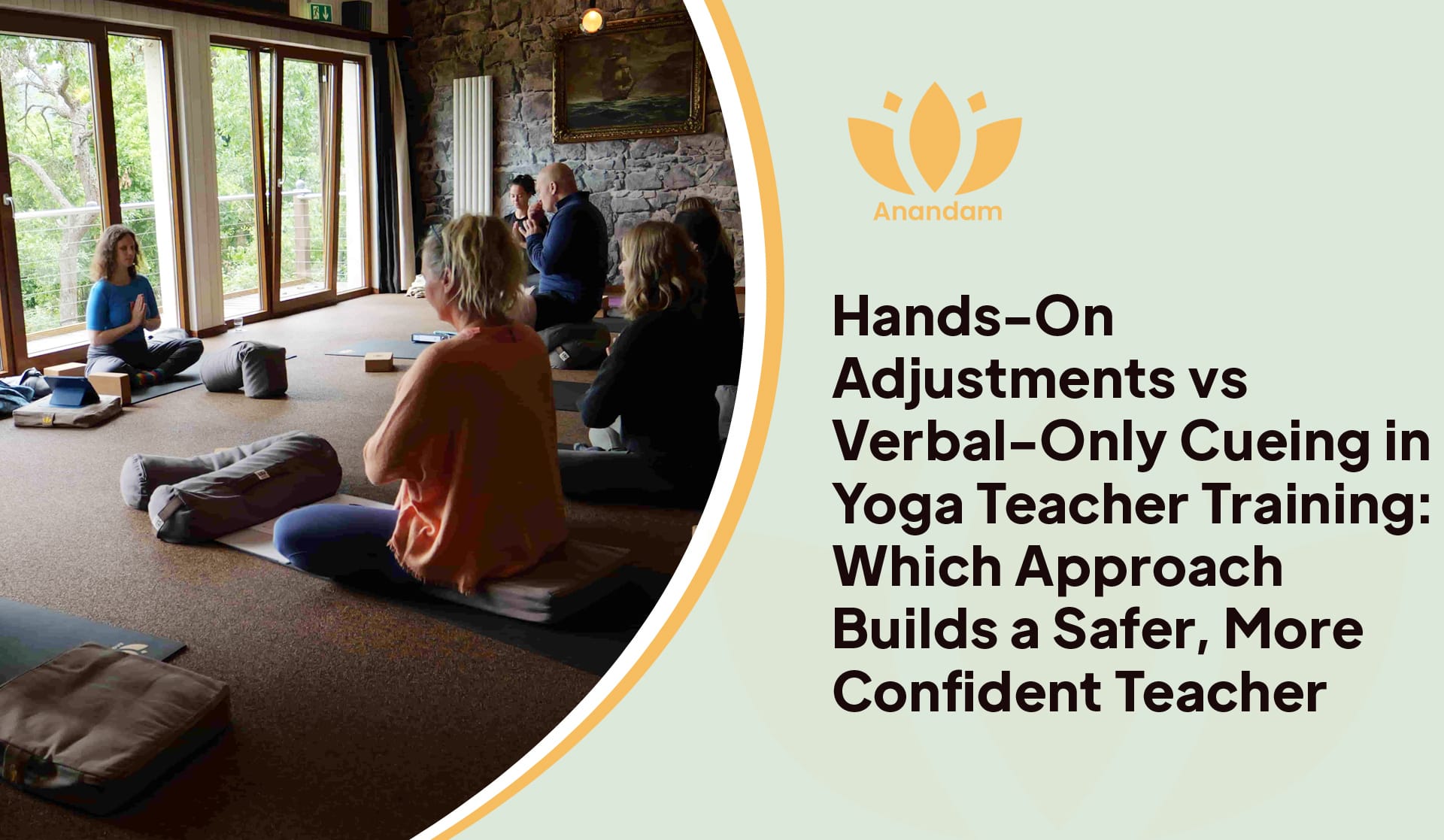
That means students practicing on each other in pairs or small groups almost from the start of the training, not saved for week three once "the basics are covered." It means a teacher in the room watching each attempt and correcting the correction, not just the pose. And it means a conversation about consent, so every student understands they can decline touch at any point, before hands-on work becomes part of daily practice.
In Sandeep's Words
"Students start teaching to each other in pairs of two and small groups from day 2 of the training, receiving feedback from each other and the teachers. This includes hands-on adjustments. Practice is how confidence is built, not by reading about it."
Yogi Sandeep Atri, E-RYT 500, Atri lineage holder
That "day 2" detail is not a small thing. Programs that delay practice teaching until the final week give trainees little time to apply feedback before certification. Starting on day two creates repeated opportunities to practice, receive correction, and try again. Our comparison of daily micro-teaching and the final practicum explains why developmental practice and final assessment serve different purposes.
The Anatomy Piece Nobody Talks About Enough
Hands-on adjustment is only as responsible as the anatomy, observation, and judgment behind it. A teacher who attempts to deepen a posture without understanding the joint, the individual body, and the purpose of the touch can cause discomfort or harm. This is why adjustment practice cannot be separated from how a program teaches anatomy in the first place.
At Anandam, Dr. Katharina Austermann, who holds a PhD in Nutrition and Food Science from the University of Bonn and has contributed to an ESA-affiliated research study on bone metabolism, teaches a daily anatomy session built around what is actually useful in the room.
"I teach an anatomy session every day, with a different focus, and I keep it practical, close to the practice. There is no point overwhelming students with complex anatomical terms and concepts that cannot be implemented into the practice. Sandeep and I both experienced this in our own trainings and decided to do it differently."
Dr. Katharina Austermann, PhD, E-RYT 500
This is the piece worth asking about directly when you are comparing schools. It is easy for a syllabus to list "functional anatomy" as a subject. It is much harder for a program to connect anatomy teaching to the specific verbal cues, props, observations, and hands-on techniques students practice that week. Our guide to what to expect during a 200-hour training in Germany explains how these learning areas fit into the wider residential program.
Consent Is Not Optional, and It Should Not Be Assumed
A decade ago, many trainings treated hands-on adjustment as something a teacher simply did, without asking. That approach has rightly changed. Consent-based adjustment means asking first, respecting a no without follow-up questions, and keeping non-touch alternatives available.
What varies a lot between schools is whether this gets taught as an explicit skill or left as an unspoken assumption. A program worth choosing will walk students through how to ask for consent naturally, without breaking the flow of a class, and how to build a classroom culture where students feel just as comfortable saying no as saying yes.
"We offer modifications, variations and alternatives for every posture, using props like blocks, belts, bolsters, cushions, blankets, chairs and walls. It is a continuing process. The more students you teach, the more you learn, because every body is different."
Yogi Sandeep Atri
That props-first mindset matters here too. A teacher trained to reach for a block or a strap before reaching for a student's body has a much wider toolkit, and a much lower risk of an adjustment that was not welcome or was not needed in the first place.
Hands-On Training vs Verbal-Only: A Side-by-Side Look
| Decision factor | Training with hands-on practice | Verbal-cueing-only training |
|---|---|---|
| Skill development | Builds tactile judgment alongside observation, verbal cueing, demonstration, and prop use | Builds communication, observation, demonstration, and non-touch adaptation without developing tactile teaching skill |
| Time requirement | Needs repeated supervised practice, consent rehearsal, anatomy integration, and feedback | Can devote more time to verbal clarity, sequencing, observation, and online or no-touch delivery |
| Best fit | Studio and small-group teachers who want touch available as an optional, consent-based tool | Online teachers, large-group teachers, and teachers or settings that intentionally maintain a no-touch policy |
| Main risk | Touch can become automatic, excessive, or unsafe when anatomy, consent, scope, or supervision is weak | Graduates may later add touch without the supervised training needed to use it responsibly |
| What to verify | How often trainees practice, who supervises, how consent is taught, and whether alternatives are assessed | How observation, demonstration, props, safety, and responsive verbal cueing are practiced and assessed |
If you are comparing delivery formats, our guide to online versus in-person yoga teacher training examines how physical presence changes observation, feedback, and teaching practice.
How to Check This Before You Enroll
The honest answer is that most program websites will not spell this out clearly, because "hands-on adjustment training" is not a marketing phrase that converts as well as "certified in 200 hours." So this becomes a question you ask directly, ideally to someone who actually teaches on the program, not just admissions staff.
Reasonable questions to ask before you book: How many days into the training does practice teaching start? Is hands-on adjustment practiced daily, weekly, or only in a single dedicated module? Who is supervising peer practice, and how large are the groups? What is the school's stated consent policy, and is it taught as its own topic?
If a program cannot answer these specifically, that is useful information on its own. Schools that have built hands-on adjustment training deliberately into their curriculum should be able to explain how the practice works day to day. Use our 21-question yoga teacher training school audit to examine the wider curriculum, faculty, practicum, assessment, and student-support structure.
This is also where small class sizes tend to matter more than they get credit for. A school running a 200-hour yoga teacher training in Germany with a genuinely small cohort can give each pair of students real, individual correction during hands-on practice sessions. That kind of attention is much harder to deliver in a program running thirty or forty students through the same room.
Where This Fits If You Are Already Comparing Programs
If you have narrowed your search down to a shortlist of schools, hands-on adjustment training is worth adding as its own item next to the usual comparison points of price, dates, and location. It sits alongside other structural questions you should already be asking, like the ones covered in our guide to the 12 questions to ask before enrolling in a yoga teacher training school.
It is also worth thinking about beyond your initial 200-hour certification. Teachers who want to deepen their adjustment and sequencing skills often continue toward a 500-hour credential, and the path there is laid out in our RYT 500 roadmap. Specialty trainings can play a role here too. Yin yoga, in particular, relies heavily on prop-based, consent-first adjustment rather than active correction, and our 50-hour Yin yoga teacher training guide covers how that specific style approaches touch and modification differently from a Vinyasa or Hatha class.
Why This Detail Is Part of Our Own Teaching Philosophy
We bring this topic up because it directly shapes how our own 200-hour training is structured. Practice teaching in pairs and small groups, including hands-on adjustment, begins on day 2, and it happens under direct supervision every time. You can read more about the team teaching it, including full credentials, on our teachers page.
Group sizes stay deliberately small for exactly this reason. Feedback on hands-on adjustment only works if a teacher can actually watch each attempt closely enough to correct it, and that becomes impossible once a room gets too full to give individual attention.
"We deliberately keep our courses smaller than other schools, because for us personal attention matters. We want to know whom we are teaching and build genuine connections. It is a more family-like environment where questions are welcome and part of the learning process."
Yogi Sandeep Atri
Frequently Asked Questions
Are hands-on adjustments required to teach yoga?
No. A teacher can lead safe, effective classes through observation, verbal cueing, demonstration, props, and student self-adjustment. Hands-on assistance is an optional skill that requires appropriate training and consent.
Should a yoga teacher ask permission before touching a student?
Yes. Consent should be clear, voluntary, and appropriate to the situation. A student may decline or withdraw consent at any time without explaining why.
Is verbal cueing enough in yoga teacher training?
Verbal cueing can be enough for online, large-group, and intentionally no-touch teaching. If a graduate plans to use hands-on adjustments, separate supervised practice is needed before adding touch.
What should hands-on adjustment training include?
It should include functional anatomy, observation, the purpose of touch, consent language, contraindications, props, non-touch alternatives, supervised peer practice, feedback, and clear professional boundaries.
Can hands-on adjustments prevent injuries?
No technique can guarantee injury prevention. Appropriate observation, clear cueing, options, props, consent, and knowing when not to touch can help a teacher respond more responsibly.
Can I decline hands-on adjustments during yoga teacher training?
Yes. Training participation should not remove bodily autonomy. A school should offer a clear opt-out process and meaningful non-touch ways to learn the same teaching decision.
Can online yoga teacher training teach hands-on adjustment?
Online learning can explain anatomy, consent, observation, and adjustment principles, but it cannot fully replace supervised tactile practice with real-time feedback.
How often should trainees practice adjustments?
There is no universal required number. Ask how often you will personally practice, who will observe, what feedback you will receive, and whether you can repeat the technique after correction.
Are props an alternative to hands-on adjustment?
Often, yes. Blocks, belts, bolsters, blankets, chairs, and walls can help students explore a posture without teacher touch, although the appropriate option depends on the person and practice.
The Bottom Line
Verbal cueing is a real, useful teaching skill, and no program should skip teaching it well. If you want hands-on adjustment to be part of your future classes, however, look for training that treats touch as an optional, consent-based skill and provides repeated supervised practice rather than a single late-stage demonstration. Before you enroll, ask directly how adjustment practice is structured, when it starts, and how consent is taught. The answer reveals a great deal about the day-to-day quality of a program.