
Written by
M.A. Yoga and Yoga Therapy, Uttarakhand University · Founder, Anandam Yoga School · Direct descendant of the Rishi Atri lineage
June 2026 · 15 min read
Quick Answer
The 200-hour yoga teacher training in Germany at Anandam Yoga School runs August 24 to September 13, 2026, over 21 days in Heimbach, Eifel National Park. A typical training day starts at 6:30am with morning practice, moves through philosophy, anatomy, teaching methodology, and supervised teaching practice, and ends around 9:00pm. All meals and accommodation are included. The training covers asana, pranayama, meditation, yoga philosophy, anatomy with Dr. Katharina Austermann, PhD, and daily teaching practice from Day 2 onward. From EUR 4,400 all-inclusive.
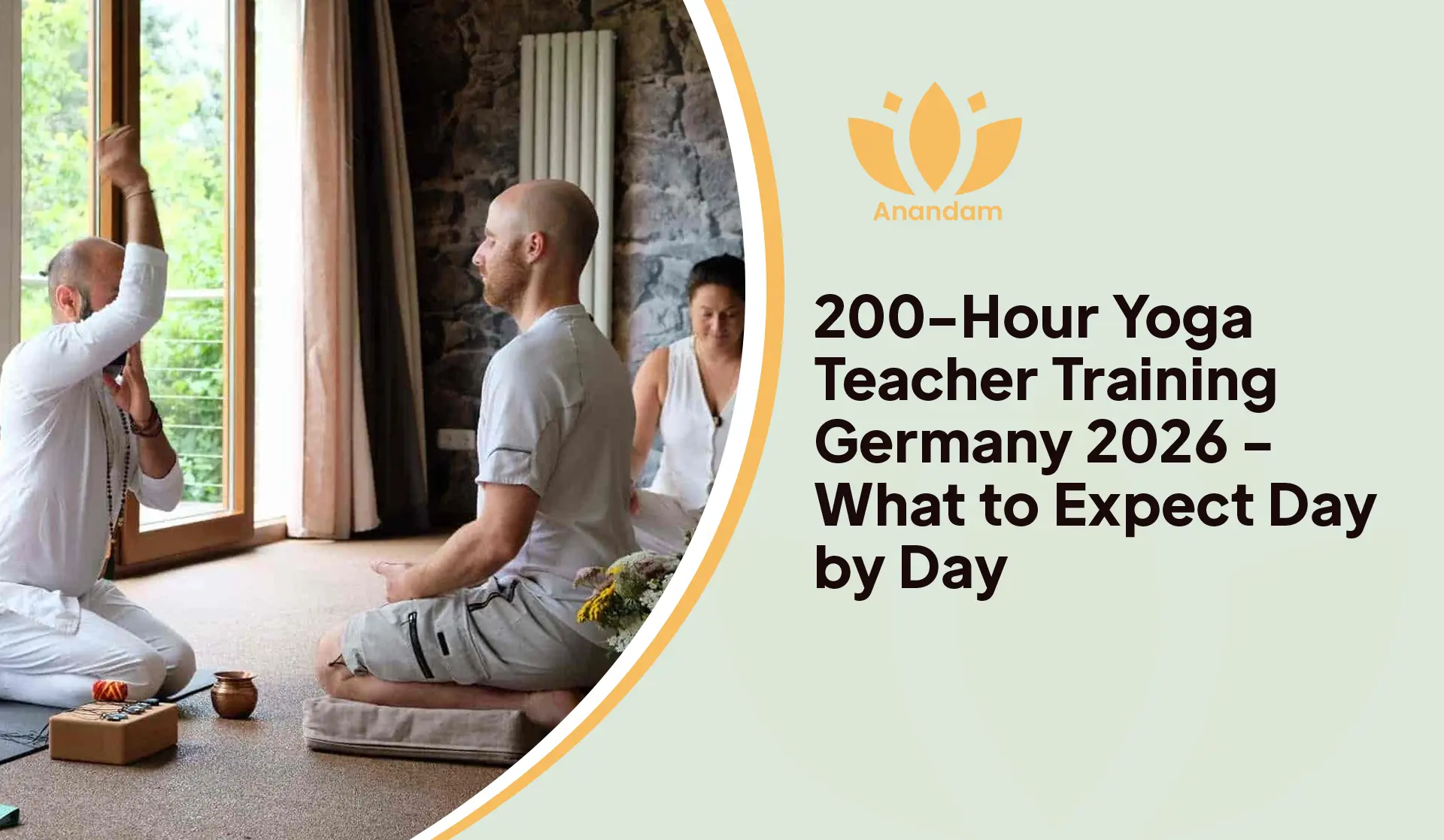
200-Hour Yoga Teacher Training Germany 2026
Heimbach, Eifel National Park · Aug 24 to Sep 13 · From EUR 4,400 · 20 nights + all meals included
View Full Program ↗The Question Every Student Asks Before Booking
What will the next 21 days of my life actually look like? This is the question underneath every other question students ask before booking a yoga teacher training. The curriculum overview and the certification details are important. But what people really want to know is what the experience feels like – what a typical morning looks like, when the hard moments come, what changes by the end of the second week, and whether 21 days is actually enough time to learn what a yoga teacher training promises to teach. I have been teaching 200-hour residential yoga teacher trainings for more than 10 years, across five countries. I have seen patterns repeat across hundreds of students. This guide is an honest account of what actually happens – not the marketing version, not the highlight reel, but the full picture of what to expect from Day 1 through Day 21 in Heimbach. The published course fee is only one part of a fair comparison. If you are comparing Anandam with online, hybrid or non-residential schools, read our German guide to the actual cost of a 200-hour yoga teacher training in Germany, including accommodation, meals, registration, travel and financing.“Most students arrive expecting a physical challenge. What they don’t anticipate is how much the quietness of the Eifel will do on its own – before the training even begins. The nervous system settles within 24 hours of arrival. That settling is not incidental to the training. It is the foundation of everything that comes after it.”
– Yogi Sandeep Atri, E-RYT 500, Founder, Anandam Yoga School
Before You Arrive – What to Prepare
The training is residential. You will live, eat, practice, and sleep in the same environment for 21 days. We chose this format on purpose. The immersive nature of the training is not an organizational convenience – it is the condition that makes the training work. Removing the daily decisions of urban life – what to eat, where to go, how to spend the evening – creates the kind of focused attention that genuine learning requires. What to bring: Comfortable practice clothes for multiple sessions per day. Layers – September in the Eifel can be cool in the mornings and evenings. Anandam provides all yoga props (mats, blocks, straps, bolsters) and study materials. What to leave behind: The mindset that this is a course to get through. The students who get the most from the training are the ones who arrive genuinely open to the experience. That shift in orientation matters more than any prior yoga experience. Travel: Heimbach is approximately 1.5 hours from Liege, 2 hours from Brussels, and 1.5 hours from Dusseldorf. Anandam collects participants from Heimbach train station. From Cologne Hauptbahnhof, the regional train to Duren and the Rurtalbahn to Heimbach takes approximately 1.5 hours total.Still deciding if Germany is the right move for your career? Read our full guide to the freelance visa process and long-term career path: The Ultimate Guide to 200-Hour YTT Germany ‐ 2026 Roadmap →
The Daily Schedule – What a Typical Training Day Looks Like
No two days in a 200-hour training are identical. But the structure is consistent, and knowing what that structure looks like helps students arrive mentally prepared rather than surprised.| Time | Session | Duration |
|---|---|---|
| 6:00am | Optional morning walk or journaling | 30 min |
| 6:30am | Shatkarma (traditional yogic cleansing practices) | 15 min |
| 6:45am | Pranayama and Meditation | 1 hour |
| 7:45am | Asana Practice (Hatha, Hatha Flow, Vinyasa) | 1.5 hours |
| 9:15am | Breakfast | 1 hour |
| 10:15am | Anatomy and Physiology / Teaching Methodology | 1.5 hours |
| 12:00pm | Asana Alignment | 1.5 hours |
| 1:30pm | Lunch Break | 1.75 hours |
| 3:15pm | Yoga Philosophy | 1.5 hours |
| 5:00pm | Practice Teaching | 1.5 hours |
| 6:30pm | Mantra Chanting | 30 min |
| 7:15pm | Dinner | Evening |
6:00am – Optional Morning Walk or Journaling
The Eifel National Park begins at the edge of the property. Students who wake early for a 30-minute walk before practice consistently describe this as one of the most valuable parts of the training – not for any formal reason, but because starting the day in forest silence, before any instruction or interaction, creates a quality of internal stillness that carries through the morning session.6:30am – Shatkarma
Each morning begins with shatkarma, the traditional yogic cleansing practices that help prepare the body and mind for practice. During the training, students learn and experience several cleansing techniques, including Jal Neti, Kapalbhati, Nauli, and Trataka. Jal Neti is practiced daily as part of the morning routine, while the other techniques are introduced progressively throughout the course with guidance and appropriate preparation. For many students, these practices are completely new. Beyond their practical benefits, they offer an opportunity to connect with aspects of traditional yoga that are often absent from modern studio classes.6:45am – Pranayama and Meditation
The day continues with pranayama and meditation. Students learn a variety of breathing techniques and meditation practices while developing a deeper understanding of how these methods influence energy, attention, and mental clarity. Rather than treating meditation as something separate from yoga practice, we explore how breath awareness, concentration, and self-observation form an integral part of the yogic path.7:45am – Asana Practice
The morning asana practice forms the physical foundation of the training. Classes include Traditional Hatha Yoga, Hatha Flow, and Vinyasa Yoga, allowing students to experience different approaches to movement, sequencing, and teaching. Throughout the course, students develop a deeper understanding of alignment and breath-movement coordination. While the sessions are physically engaging, the focus is never on performance. The emphasis is on learning and developing a sustainable relationship with practice. Once per week, students also experience a Yin Yoga class as part of their personal practice journey.9:15am – Breakfast
Breakfast provides time to nourish both body and mind after the morning practice. Meals are prepared fresh and designed to support the demands of an intensive training while creating space for students to connect, reflect, and enjoy a slower pace before the next learning session begins.10:15am – Anatomy and Physiology / Teaching Methodology
These morning lectures alternate between anatomy and physiology and teaching methodology. In anatomy sessions with Dr. Katharina Austermann, students explore how the body moves and functions in yoga practice. Topics include the musculoskeletal system, breathing mechanics, the relationship between yoga practice and the nervous system, and practical applications for teaching safely and effectively. Teaching methodology sessions focus on the skills required to guide others – how to structure classes, communicate instructions effectively, create inclusive learning environments, and adapt practices for different needs and abilities. These are interactive sessions where questions, discussion, and critical thinking are encouraged.12:00pm – Asana Alignment
Alignment sessions provide an opportunity to explore postures in greater detail. Students examine the purpose, benefits, variations, and teaching considerations of more than 100 asanas while learning how bodies can experience the same posture differently. Rather than focusing on achieving a “perfect shape,” the emphasis is on understanding functional alignment, individual differences, and how to support students safely and effectively.1:30pm – Lunch Break
The extended lunch break offers time to eat, rest, connect with fellow students, or simply enjoy some quiet time. Intensive learning requires periods of recovery, and this pause in the middle of the day allows space for both physical and mental integration.3:15pm – Yoga Philosophy
Yoga philosophy provides the framework that connects all aspects of the training. Students explore classical yogic teachings, including the Yoga Sutras, the Eight Limbs of Yoga, the Pancha Kosha model, and teachings from the Atri lineage. Rather than approaching philosophy as abstract theory, discussions focus on how these teachings can be understood and applied in daily life, personal practice, and teaching.5:00pm – Practice Teaching
From the second day of the training onward, students begin teaching regularly. Working in pairs and small groups, they gradually develop the confidence and practical experience required to guide others. Teaching fellow students creates a supportive environment where mistakes become learning opportunities and feedback is part of the process. For many participants, this becomes one of the most valuable parts of the training.6:30pm – Mantra Chanting
The day concludes with mantra chanting. Students are introduced to traditional Sanskrit mantras and their role within the yogic tradition. Chanting offers an opportunity to cultivate focus, presence, and a sense of connection while ending the day together as a community. For some students this becomes a cherished daily ritual, while for others it offers a meaningful introduction to a practice they may never have experienced before.7:15pm – Dinner
Dinner marks the end of the structured training day and offers an opportunity to slow down, share experiences, and connect with fellow students outside the classroom. Meals are enjoyed in a relaxed and welcoming atmosphere. While the curriculum provides the framework for learning, many meaningful conversations and friendships begin around the dinner table.Week by Week – What Changes
Week 1 – Foundation and Disorientation (Days 1-7)
The first week is simultaneously the most exciting and the most disorienting. Students arrive with high energy and genuine enthusiasm. Within 48 to 72 hours, something often shifts. The physical demands of daily practice sessions settle into the body and the philosophy begins to challenge assumptions students did not know they had. The teaching practice starts – and most students discover that the gap between how they imagined they would teach and how they actually teach in front of a live group is larger than expected. This is normal. It is, in fact, the point. The disorientation of Week 1 is the beginning of genuine learning. Students who are uncomfortable in Week 1 are typically the ones who experience the biggest growth by Week 3. One student who joined the August 2025 training from Belgium described her Week 1 experience this way: “I had been practicing yoga for 6 years. I arrived thinking I understood yoga fairly well. By Day 3, I realized I had been practicing postures and did not really know what yoga was.” What students commonly struggle with in Week 1:- Physical fatigue from daily yoga practice, teaching exercises, and long training days
- Mental fatigue from the intensity of learning — many students have not been in a structured learning environment for years
- The vulnerability of teaching in front of peers from Day 2
- The gap between how philosophy feels when reading about it and how it lands in daily life
- That the Eifel environment settles something in the nervous system that they had not realized was activated
- That the small group size (maximum 15) creates a quality of attention that feels different from any prior training experience
- That the philosophy sessions open questions they did not know they were carrying
Week 2 – Deepening Understanding and Practice (Days 8-14)
In Week 2, students begin to connect many of the concepts introduced during the first week and explore them in greater depth. The anatomy and physiology sessions focus on specific regions and movement patterns that are particularly relevant to yoga practice, including pelvis and hip anatomy, spinal movement, myofascial lines, and the relationship between emotions, tension, and the hip region. As the training progresses, students often begin to see how anatomy, philosophy, breathwork, and asana practice are interconnected rather than separate subjects. Concepts that initially seemed theoretical start to make sense through direct experience on the mat and in daily practice. Teaching practice continues in the same supportive format. Most students notice that their confidence grows significantly during the second week. Instructions become clearer, communication feels more natural, and teaching gradually shifts from remembering what to say toward focusing on whom they are teaching. For many participants, Week 2 is where the different elements of the training begin to come together. The initial feeling of being overwhelmed by new information starts to settle, and students develop a deeper trust in both their own practice and their emerging teaching skills.Week 3 – Integration, Confidence, and Teaching (Days 15-21)
Students have spent two weeks practicing, studying, discussing, teaching, and learning together. This shared experience creates a sense of confidence and trust within the group. The final week places a stronger emphasis on teaching practice. Building on the foundations developed throughout the course, each student prepares and teaches a complete 1.5 to 2-hour yoga class that includes asana, pranayama, and meditation. Alongside teaching practice, students continue exploring complementary topics such as Ayurveda and deepen their understanding of the connections between philosophy, anatomy, breathwork, and practice. On Day 20, students complete the theory examination. The final day begins with the morning practice before concluding with a closing ceremony. While the certification marks the completion of the 200-hour training, most students leave with the feeling that their learning journey is only beginning. The final days are often characterized by reflection and a deeper appreciation for both the practice of yoga and the community that has developed over the previous three weeks.What the Eifel National Park Does to the Experience
This is worth its own section because students consistently underestimate how much the environment shapes the training. Heimbach is inside the Eifel National Park. The center is surrounded by ancient forest, volcanic lakes, and river valleys. There is genuine silence here – not the relative quiet of a suburban location, but the kind of silence that only exists when you are immersed in nature. For most students, particularly those from Belgium, the Netherlands, and Germany’s major cities, arriving in Heimbach produces a physical shift within the first 24 to 48 hours. The nervous system, used to the constant low-grade activation of everyday life, begins to settle and sleep quality improves. Sustained concentration, internal stillness, and the ability to be genuinely present become easier. This is basic nervous system physiology – a quieter environment produces a more receptive learning state. The Eifel is the condition that makes 21 days of intensive training genuinely integrable rather than exhausting.The Philosophy Curriculum – What Gets Taught and Why
The philosophy curriculum at Anandam is taught from the lineage, not from a textbook. This is an important distinction. Most yoga teacher training programs cover yoga philosophy as a required curriculum category – a set of concepts to be learned and reproduced. The Yoga Sutras of Patanjali are taught as a list of aphorisms with explanations and the eight limbs are memorized. What I teach is different because my relationship to this material is different. I was not introduced to the Yoga Sutras in a training program – they were part of my daily life from childhood. The philosophical texts of the tradition were part of my upbringing, taught to me by family elders within the Atri lineage as living knowledge. The difference in a classroom is not about what is covered, but about the way knowledge is delivered. I use real-life examples and stories to allow for a deeper understanding of complex concepts. Students consistently describe the philosophy sessions as the unexpected center of the training, as the teachings invite them to reflect on their own choices, patterns, and experiences in everyday life. The curriculum covers:- The history and paths of yoga – exploring the origins and evolution of yoga and the different traditional paths that guide practitioners toward self-understanding
- The Yoga Sutras of Patanjali – one of the foundational texts of yoga philosophy, offering practical guidance for understanding the mind and living with greater awareness
- The Eight Limbs of Yoga – providing a framework for integrating yogic principles into everyday life beyond the physical practice of asana
- The Pancha Kosha model, the five elements, nadis, prana, chakras, and bandhas – exploring traditional yogic perspectives on the human experience, energy, and consciousness
- The Atri lineage teachings – sharing the wisdom, practices, and philosophical foundations passed down through the Atri tradition
The Anatomy Curriculum – What Makes It Different
Anatomy and physiology at Anandam is taught by Dr. Katharina Austermann, who holds a PhD in Nutrition and Food Science from the University of Bonn (2023). She is also an E-RYT 500 yoga teacher, which means her anatomy teaching integrates research-level scientific understanding with the perspective of a practitioner who has lived the physical reality of what she is teaching. The anatomy curriculum covers:- The structural design of the human body, including posture, alignment, and the body’s center of gravity
- The nervous system and its role in stress regulation, relaxation, and yoga practice
- The respiratory system, including breathing mechanics and the physiological effects of pranayama
- The cardiovascular system and its role in circulation, exercise, and overall health
- The musculoskeletal system, with a focus on movement, posture, and functional anatomy for yoga practice
- Hip anatomy, including structure, mobility, stability, and the relationship between emotional stress, tension, and the hip region
- Spine, back, and core anatomy, exploring how these areas support movement, balance, and healthy yoga practice
Teaching Practice – Learning by Teaching
Teaching practice is woven throughout the entire training and begins on the second day. Rather than waiting until students feel “ready,” we encourage them to start teaching from the beginning in a supportive and structured environment. Students work in pairs and small groups, taking turns guiding postures, class openings, pranayama practices, meditation, and short teaching sequences. This allows them to develop confidence gradually while receiving regular feedback from both fellow students and the lead teachers. As the training progresses, students begin integrating the different aspects of teaching they have been learning throughout the course – clear communication, sequencing, observation, adaptation, and presence. The final week places a stronger emphasis on teaching practice, culminating in each student teaching a complete 1.5 to 2-hour yoga class that includes asana, pranayama, and meditation. Total supervised teaching hours across the 21 days: approximately 12-15 hours per student. For many students, teaching practice becomes one of the most valuable parts of the training. It is where the transition from student to teacher begins to take shape.Looking to Specialize After Your 200hr?
The 100-hour Pre and Postnatal Yoga Teacher Training runs July 6-15 and November 20-29, 2026 in Heimbach. Led by Dr. Katharina Austermann, PhD. EUR 2,200 all-inclusive.
The Questions Students Ask Most Before Arriving
“Am I fit enough for the physical demands?”
The 200-hour training requires a personal yoga practice, but not an advanced one. The morning asana sessions are appropriate for practitioners with 1 or more years of practice. There will be days when the physical demand feels high and there will also be days when the practice is gentle. The training is designed to challenge without exceeding capacity.“Will I be able to keep up with the philosophy?”
Yes. No prior study of yoga philosophy is required or assumed. The only requirement is genuine curiosity and openness to learning new concepts.“What if I am terrible at teaching practice?”
This is the most common fear before arriving and the one that resolves most completely by Week 2. The teaching practice is designed to develop you from wherever you are, not to assess whether you already have natural teaching ability.“Is 21 days a long time to be away from home?”
For most students, 21 days feels both longer and shorter than they expected. Longer because the depth of immersion creates a quality of experience that does not compress easily. Shorter because the structure is full and the time passes with a quality of presence that feels different.“What happens after the training – how do I register as an RYT 200?”
After graduation, you register directly on the Yoga Alliance website (yogaalliance.org) as an RYT 200, upload your certification and Anandam will confirm your training record. The registration fee is approximately USD 115 for the first year, paid directly to Yoga Alliance. Once registered, your credentials are searchable by studios and clients worldwide.What Students Commonly Take Away from the Training
Every student arrives with different expectations. Some come because they want to teach yoga. Others join to deepen their personal practice or reconnect with themselves through a period of focused study and reflection. While every experience is unique, certain themes appear consistently. Students frequently describe the training as intensive, supportive, and deeply rewarding. Many highlight the balance between traditional yogic teachings, practical teaching experience, and modern anatomical understanding, as well as the strong sense of community that develops within the group. One graduate described the training as “one of the most intense and rewarding experiences” and shared that it led to “a much deeper understanding of yoga as a holistic practice.” Another reflected on feeling guided “with compassion and love to find my own voice as a teacher, but also as a human on this earth.” Students also regularly mention the welcoming atmosphere created by the small group setting. As one participant wrote, “Every person’s opinion mattered, and all questions were welcomed with openness.” Perhaps the most common feedback is that students leave with much more than a certificate. They leave with a stronger foundation in yoga, greater confidence in their ability to teach, meaningful friendships, and a deeper understanding of how yoga can be integrated into daily life.Is There a 200-Hour Yoga Teacher Training in Germany That Includes Accommodation and Meals?
Yes. Our 200-hour training in Heimbach, Eifel National Park, is fully residential and all-inclusive: 20 nights of accommodation, three fresh vegetarian meals daily, all tuition and course materials, and the Yoga Alliance RYT-200 certification are covered in one price of €3,900 early bird / €4,400 (private room €4,200 / €4,700). The only things you add are travel to Heimbach, travel insurance, and the optional Yoga Alliance first-year registration (about €100). When comparing any school’s “all-inclusive” claim, ask for exactly this breakdown; some programs price tuition and accommodation separately.2026 Dates and Pricing
Dates: August 24 to September 13, 2026 (21 days, 20 nights) Location: Hausener Str. 300, 52396 Heimbach, Eifel National Park, Germany| Room Type | Price | Includes |
|---|---|---|
| Shared Twin Room | EUR 3,900 (Early Bird) / EUR 4,400 (Regular) | 20 nights + all meals daily |
| Private Double Room | EUR 4,200 (Early Bird) / EUR 4,700 (Regular) | 20 nights + all meals daily |
A deposit of EUR 500 secures your place. Group size: maximum 15 students. For full curriculum details and how to apply: 200 Hours Yoga Teacher Training Germany
Frequently Asked Questions
Is accommodation included in the 200-hour yoga teacher training in Germany?
Yes. The training is fully residential and all-inclusive: 20 nights of accommodation in Heimbach, three fresh vegetarian meals daily, all tuition and course materials, and the Yoga Alliance RYT-200 certification are covered in one price of €3,900 early bird / €4,400 (private room €4,200 / €4,700).What is the daily schedule for the 200-hour yoga teacher training in Germany?
A typical day begins at 6:30am with shatkarma, followed by pranayama, meditation, and asana practice, before continuing with anatomy, teaching methodology, alignment, philosophy, and daily teaching practice. The day concludes with mantra chanting, creating a balanced schedule that combines physical practice, theoretical study, self-reflection, and hands-on teaching experience.How much teaching practice is included?
Students begin teaching on the second day of the training and practice throughout the entire course in pairs and small groups. In the final week, each student teaches a complete 1.5 to 2-hour yoga class including asana, pranayama, and meditation. Total supervised teaching hours across the 21 days are approximately 12-15 hours per student.Do I need to be an advanced practitioner to join?
No. A personal yoga practice of 1 or more years is recommended. No prior teaching experience is required. The training is designed to develop teachers from wherever they are.What is included in the price?
All accommodation, all meals (breakfast, lunch, and dinner daily), all tuition, course materials, and the Yoga Alliance certification fee. Not included: travel to Heimbach, Yoga Alliance first-year registration fee (approximately EUR 100), personal expenses, travel insurance.What is the Eifel National Park like as a training location?
Heimbach is inside one of Germany’s national parks, surrounded by ancient forest, volcanic lakes, and river valleys. It is approximately 1.5 hours from Liege and Dusseldorf, 2 hours from Brussels, and 1.5 hours by train from Cologne. The natural environment and absence of urban noise consistently contribute to the quality of learning. Most students describe it as a very important factor in the training experience.How do I get to Heimbach?
By car: entirely motorway until the final stretch through the Eifel. By train: travel to Duren (Nordrhein-Westfalen) by any regional or intercity train, then the Rurtalbahn regional train to Heimbach (Eifel). Anandam collects participants from Heimbach train station. From Cologne Hauptbahnhof, total train journey is approximately 1.5 hours.What happens if I cannot complete the training due to illness or emergency?
Contact info@anandamyogaschool.com to discuss. The school handles these situations individually and with flexibility.Can I join the 300-hour advanced training in the same year?
Yes. The full RYT 500 pathway can be completed in a single year: 200-hour in August followed by the 300-hour advanced training October 19 to November 12, 2026. A break of approximately 5 weeks separates the two programs. This is also the ZPP-eligible pathway for teachers planning to work in the German market.Ready to Join the August 2026 Training?
200-Hour Yoga Teacher Training Germany · Aug 24 to Sep 13, 2026
Heimbach, Eifel National Park · From EUR 4,400 · 20 nights + all meals · Max 15 students
Enquire: info@anandamyogaschool.com
Related Reading
- → 200-Hour Yoga Teacher Training Germany 2026 – Full Curriculum and Pricing
- → Yoga Teacher Training Cost in Europe 2026 – Full Comparison
- → Yoga Teacher Career in Germany 2026 – Salary, ZPP and Jobs
- → 300-Hour Advanced YTT Germany 2026 – ZPP Pathway
- → Yoga Teacher Training Germany for Belgian and Dutch Students
- → About Yogi Sandeep Atri
- → About Dr. Katharina Austermann, PhD