
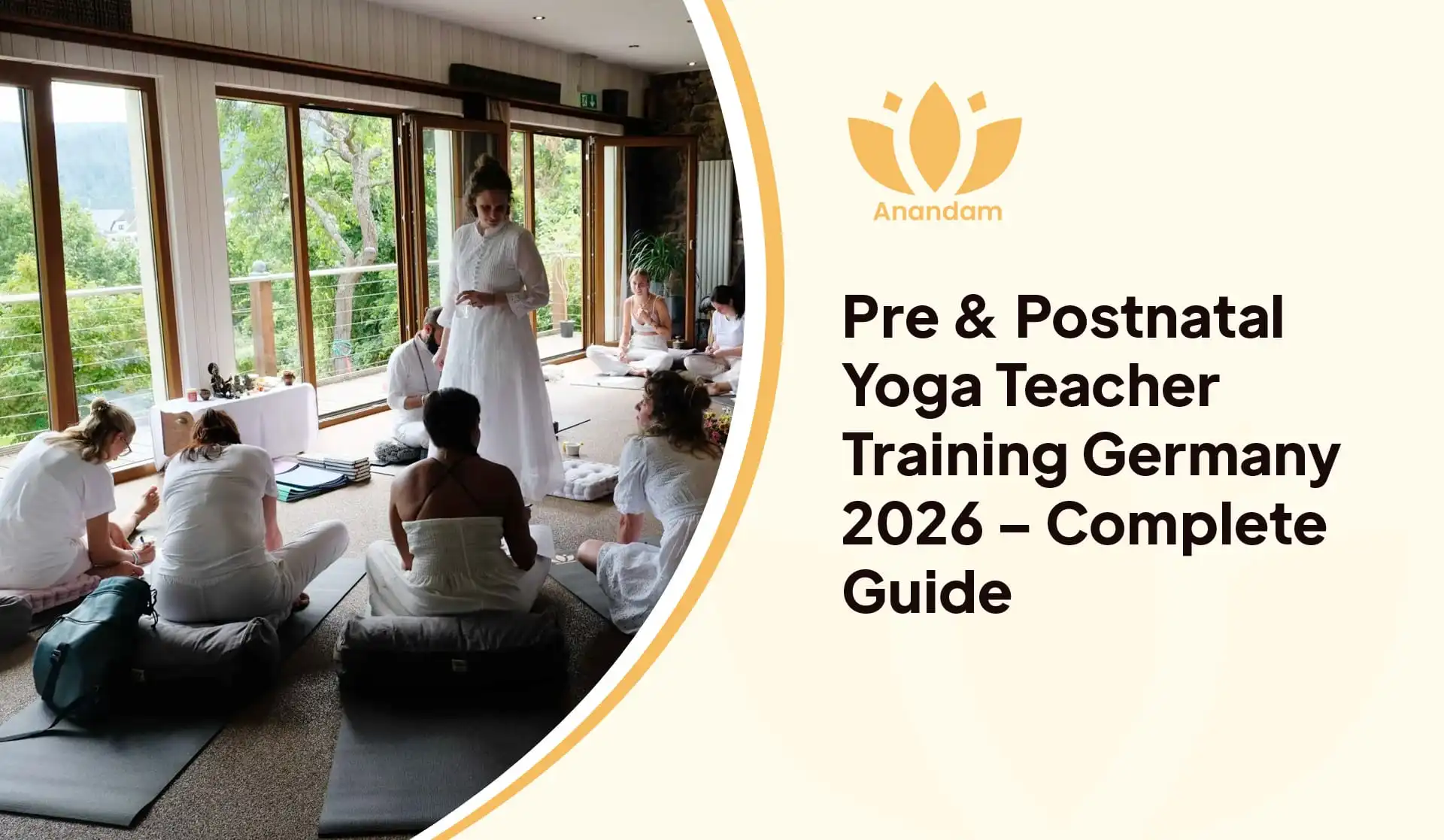
Pre & Postnatal Yoga Teacher Training Germany 2026 – Complete Guide.
- Anandam Yoga
- Last updated: September 4, 2026
Written by
PhD in Nutrition and Food Science, University of Bonn (2023) · E-RYT 500 · Lead facilitator, Pre and Postnatal Program, Anandam Yoga School
April 29, 2026 · Updated June 2026 · 14 min read
A pre and postnatal yoga teacher training qualifies yoga teachers to design and lead pregnancy yoga classes and postnatal recovery classes safely and with clinical confidence. In Germany, Anandam Yoga School offers a 100-hour pre and postnatal yoga teacher training at Heimbach in the Eifel National Park, in two 2026 programs: July 6-15 and November 20-29. The training is led by Katharina Austermann, PhD in Nutrition and Food Science (University of Bonn, 2023) and Yogi Sandeep Atri (E-RYT 500). This dual nutrition science and yoga teaching perspective makes Anandam's pre and postnatal training unique in the European yoga teacher training market. Price: EUR 2,200 (10 nights residential, all meals included).
Pregnancy yoga is one of the most rapidly growing areas of the yoga industry in Europe - and one of the most important to get right. The stakes are different from a general yoga class. The person in front of you is carrying another life. The poses, the sequencing, the language you use, and the contraindications you know - or do not know - will directly affect two people's wellbeing.
Most yoga teachers who work with pregnant students have never had specific pre and postnatal training. They apply general yoga principles with a few modifications they have heard about - no backbends in the first trimester, careful with inversions, watch the belly. This is not enough. What the research and clinical practice consistently shows is that the difference between a well-trained pre and postnatal yoga teacher and an untrained one is the difference between a class that genuinely supports maternal wellbeing and one that causes anxiety - or, in rare cases, harm.
This training exists to close that gap.
The 100-hour format is not valuable simply because it is longer. It creates room for pregnancy and postpartum physiology, varied student situations, supervised teaching, feedback, and referral boundaries. For the wider decision framework, read our 50-hour vs 100-hour yoga teacher training guide.
Pre and Postnatal Yoga Teacher Training - Germany 2026
Jul 6-15 · Nov 20-29 · Heimbach, Eifel · YACEP 100hrs · EUR 2,200 all inclusive
View Program and Enrol ↗Who Needs This Training and Why
In our experience teaching pre and postnatal yoga in Heimbach, the students who benefit most are not always who you might expect. The training draws a wide range of participants - and all of them leave with something they could not have built from a general yoga teacher training alone.
Yoga teachers with pregnant students in their classes. If you teach group yoga classes, the statistical probability is that you already have pregnant students attending. Without specialist training, you are making sequencing decisions in real time without the physiological foundation to make them well. This training gives you the clinical confidence to work safely.
Yoga teachers who want to build a specialism. Pre and postnatal yoga is one of the highest-demand specialisms in the European yoga market. Studios, hospitals, midwife practices, and corporate maternity programs all seek qualified prenatal yoga teachers. The specialism commands higher rates and builds a specific, loyal client base.
Midwives, health visitors, and maternal healthcare workers. If you work clinically with pregnant and postpartum women, yoga-based tools - breathwork, nervous system regulation, pelvic floor awareness, restorative movement - are evidence-supported additions to your practice. The training gives you the practical skills to integrate them.
Doulas and birth workers. Yoga as birth preparation is one of the most practically useful services a doula can offer. This training gives you the evidence base and the specific practices.
Yoga teachers in private practice. One-to-one prenatal yoga sessions are one of the highest-value services a yoga teacher can offer - both in terms of income and in terms of the depth of support you can provide to a single client across her pregnancy and postpartum journey.
Why a Nutrition and Metabolic Health Specialist Changes Everything
Most pre and postnatal yoga programs are led by experienced yoga teachers who have either gone through pregnancy themselves or have supported many pregnant students. Their experiential knowledge is valuable, but it is not the same as clinical understanding.
I joined this training as a co-facilitator because I recognized a gap that needed to be addressed. As both a mother and a specialist in women's metabolic and hormonal health, I bring a perspective that integrates lived experience with evidence-based physiology.
Pregnancy and the postnatal period involve profound and measurable changes. These include the hormonal cascade of the third trimester, the structural adaptations of the pelvis and spine, cardiovascular shifts, immune modulation, and the increased metabolic demands, especially during breastfeeding. These are not just general concepts - they are physiological realities that directly influence how yoga should be sequenced, modified, or sometimes avoided.
For example, when a teacher understands that relaxin - the hormone responsible for ligament laxity - can remain in the body for up to 3 to 6 months postpartum and often longer during breastfeeding, their approach to stability, mobility, and intensity changes significantly. When they understand the cardiovascular load of the third trimester, they stop encouraging overly forceful breathwork such as vigorous Ujjayi. When they can clearly differentiate between diastasis recti and general postpartum core weakness, they guide recovery with precision instead of defaulting to inappropriate exercises.
It is also essential to recognize that the postpartum phase does not simply end after a few weeks. As long as a woman is breastfeeding, her body remains in a postnatal, hormonally distinct state. This period is one of the most physiologically vulnerable times in a woman's life, yet it is often underrepresented and insufficiently addressed in standard trainings.
To my knowledge, this level of integration - combining clinical insight, metabolic and hormonal expertise, and lived maternal experience - is not currently offered elsewhere in the European pre and postnatal yoga training space.
What Makes This Training Different From Others
There are pre and postnatal yoga trainings available across Europe. Here is an honest comparison of what sets this one apart.
| Factor | Anandam Germany | Standard Prenatal Module | Standalone Online Course |
|---|---|---|---|
| Duration | 100 hours dedicated | 10-20 hrs within 200hr | 20-50 hours |
| Nutrition science | PhD-level (Katharina) | Not included | Rarely included |
| Postpartum focus | Full dedicated curriculum | Minimal | Varies |
| Format | Residential - live with teachers 10 days | Part of wider training | Online self-paced |
| YACEP certified | Yes - 100 hours | Varies | Varies |
| Group size | Max 15 students | Varies | No limit |
| Price (all-in) | EUR 2,200 incl accommodation + meals | Included in 200hr cost | EUR 300-800 tuition only |
What the Training Covers - Full Curriculum
Pregnancy Physiology - The Essential Medical Foundation
The training opens with a thorough grounding in what is actually happening in the body during each trimester. Hormonal changes (HCG, progesterone, relaxin, oestrogen and their implications for joints, mood, and energy), cardiovascular changes (increased blood volume, heart rate, blood pressure), respiratory changes (diaphragm displacement, breathlessness), musculoskeletal changes (centre of gravity, pelvic girdle pain, diastasis recti), and the neurological and hormonal story of the postnatal period including the fourth trimester. This is the foundation for every sequencing and modification decision you will make in a pre and postnatal class.
Trimester-Specific Yoga Practice and Teaching
Each trimester has distinct needs, capacities, and contraindications.
First trimester (weeks 1-13): Energy is often low, nausea is common, risk of miscarriage is highest. Yoga practice should be gentle, grounding, and focused on breath awareness and pelvic floor connection. This is not the time for strong heat-building practice.
Second trimester (weeks 14-26): Often the most energetic period. The uterus is large enough to require modifications to forward bends and supine poses. Standing balance poses need adaptation as the centre of gravity shifts.
Third trimester (weeks 27-40): Significant physical constraints. The focus shifts toward preparation for birth - hip opening, pelvic floor awareness, relaxation, and breathing techniques specific to the different stages of labour.
Pelvic Floor - The Most Underaddressed Topic
Pelvic floor health is central to pre and postnatal yoga teaching and profoundly underaddressed in most yoga teacher trainings. The training covers pelvic floor anatomy and function, how pregnancy and birth affect pelvic floor integrity, the difference between a hypertonicity and hypotonicity (they have completely different implications for yoga practice), and how to cue pelvic floor engagement appropriately in a yoga class context.
Common Pregnancy Discomforts - Yoga as Therapeutic Response
Lower back pain, symphysis pubis dysfunction and pelvic girdle pain, carpal tunnel syndrome, round ligament pain, heartburn, sciatic nerve compression, leg cramps, and oedema. For the most common conditions the training focuses on practical and safe yoga modifications, along with guidance on when to support through yoga and when to refer to a healthcare provider.
Labor and Birth Preparation
How yoga practices specifically support the different stages of labor: hip-opening sequences for the latent phase, active movement and position changes for active labor, breathing techniques and vocalization, and restorative practices for managing intensity.
The Postnatal Period - Fourth Trimester and Beyond
The training covers: when it is safe to return to different types of yoga practice after vaginal birth and c-section; how to sequence appropriately for each stage of recovery; postnatal diastasis recti - how to identify it, how to work with it, and when to refer; the specific nutritional and metabolic demands of the postnatal period; and how to create a supportive class environment for women who are sleep-deprived, emotionally vulnerable, and adjusting to this significant life change.
2026 Program Dates - Germany
| Batch | Dates | Duration | Price |
|---|---|---|---|
| Batch 1 | July 6-15, 2026 | 10 nights, all meals included | EUR 2,200 |
| Batch 2 | November 20-29, 2026 | 10 nights, all meals included | EUR 2,200 |
For full curriculum details, accommodation options, and how to apply, visit the 100-hour pre and postnatal yoga teacher training Germany course page. Group size is capped at 15 students per batch.
Career After Pre and Postnatal Yoga Teacher Training
Pre and postnatal yoga is one of the most commercially sustainable specialisms a yoga teacher can build. The demand is consistent, the client base is loyal, and the clinical credibility of a dedicated 100-hour certification - especially one with Katharina's nutritional science dimension - supports premium pricing.
In our experience, graduates from this training return to their markets and find opportunities in several distinct areas:
Studio prenatal yoga classes. Most yoga studios in Germany, Belgium, the Netherlands, and the UK actively seek qualified prenatal yoga teachers. A 100-hour YACEP-certified qualification from a school with Katharina's academic background is a genuinely strong credential in this market. Group class rates for specialist prenatal yoga typically run EUR 40-80 per session in the European market.
Private one-to-one prenatal yoga. One-to-one prenatal yoga sessions are one of the highest-value services a yoga teacher can offer. Clients book private sessions because they want individualized attention for their specific pregnancy, body, and concerns. Rates for private prenatal yoga in Germany typically range from EUR 80-150 per session.
Postnatal yoga and mother and baby classes. The postnatal period is chronically underserved in most yoga markets. A teacher qualified in postnatal recovery - pelvic floor rehabilitation, diastasis recti-safe sequencing, nervous system support for new mothers - fills a genuine gap that most studios cannot yet address.
Corporate maternity wellness programs. Large companies in Germany, Belgium, and the Netherlands increasingly offer prenatal yoga as part of their employee benefits. ZPP-certified teachers have access to insurance-reimbursed corporate wellness programs. The yoga teacher career in Germany guide covers the ZPP pathway in detail.
Collaboration with midwives and healthcare providers. Midwife practices, maternity hospitals, and obstetric physiotherapy clinics are increasingly open to collaboration with qualified prenatal yoga teachers. The clinical depth of this training - particularly the nutritional and metabolic science contributed by Katharina - creates a professional credibility that supports these relationships.
Combined yoga therapy and nutrition support. For graduates who also have a background in nutrition or healthcare, the combination of prenatal yoga teaching with Katharina's metabolic and hormonal health support creates a genuinely distinctive service offering for women navigating the full perinatal period.
Pre and Postnatal Yoga Teacher Training Germany 2026
100 hours YACEP · Heimbach, Eifel National Park · Led by Dr. Katharina Austermann, PhD · EUR 2,200 all-inclusive · Max 15 students
Frequently Asked Questions
Do I need a prenatal yoga certification to teach pregnant women?
Yes. Teaching yoga to pregnant women without specialist training carries real risk. Pregnancy involves specific physiological changes - relaxin production, cardiovascular shifts, pelvic girdle adaptations, diastasis recti risk - that a standard 200-hour training does not cover in adequate depth. A dedicated pre and postnatal certification gives you the clinical confidence to work safely with pregnant and postpartum students.
Do I need a 200-hour certification to join?
An RYT 200 is recommended but not mandatory. Midwives, doulas, physiotherapists, and other healthcare practitioners with a personal yoga practice and clinical background are considered on a case-by-case basis. Contact info@anandamyogaschool.com to discuss your background directly.
Can I join during pregnancy?
Please contact info@anandamyogaschool.com directly to discuss your specific situation and stage of pregnancy. Each case is considered individually with your wellbeing as the first priority.
Can I bring my baby to the training?
Please contact us directly to discuss. Enquiries are handled individually depending on the age of the baby and practical logistics at the Heimbach center.
What ongoing support is available after graduation?
Graduates receive access to course materials and recordings for ongoing professional reference. Katharina Austermann is available for professional questions related to the curriculum content. Contact info@anandamyogaschool.com for details on post-graduation support.
How much focus is there on the postpartum period?
Significant curriculum time is dedicated to the fourth trimester and postnatal recovery - pelvic floor rehabilitation, diastasis recti identification and management, the hormonal and metabolic demands of breastfeeding, and returning to yoga practice safely after both vaginal birth and c-section. The postpartum period is treated as a distinct and clinically important phase, not an afterthought.
What makes this training different from others?
The training is co-led by Dr. Katharina Austermann, who holds a PhD in Nutrition and Food Science (University of Bonn, 2023) alongside her E-RYT 500 certification and pre and postnatal yoga qualification. No other European prenatal yoga training currently integrates doctoral-level nutritional and metabolic science with yoga teaching in this way. See the comparison table above for a detailed breakdown.
What is the philosophy behind this prenatal yoga training?
The training is grounded in the belief that pregnancy and the postnatal period deserve the same clinical rigor and individual care as any other significant phase of a woman's physiological life. Yoga is approached as a therapeutic and supportive practice - not a fitness class with modifications. The integration of traditional yogic practices with evidence-based nutritional and metabolic science reflects Anandam's broader approach: authentic lineage teaching combined with modern scientific understanding.
Is this training recognized internationally?
Yes. The training is 100 YACEP hours certified by Yoga Alliance, recognized in 160+ countries. YACEP hours count toward Yoga Alliance continuing education renewal for existing RYT holders. For more on how YACEP works, see the YACEP guide for Germany 2026.
Can I teach postpartum classes after this training?
Yes. The curriculum covers both prenatal and postnatal yoga teaching in full. Graduates are qualified to teach pregnancy yoga classes, postnatal recovery classes, mother and baby yoga, and to offer private prenatal and postnatal yoga sessions across the full perinatal continuum.
What are the 2026 dates?
July 6-15 and November 20-29, 2026 at Heimbach, Eifel National Park. EUR 2,200 per batch (10 nights residential, all meals included).
Is it safe to practice yoga in the first trimester?
In a healthy pregnancy without complications, gentle yoga is safe with modifications. Strong twists, vigorous inversions, and extended supine lying should be avoided. Anyone with a high-risk pregnancy or history of miscarriage should consult their midwife or obstetrician before practicing.
When can postnatal yoga begin after birth?
Gentle restorative work and breath and pelvic floor awareness can begin within 1-2 weeks of vaginal birth. More active practice after the 6-week check. C-section recovery requires a longer timeline - typically 12 or more weeks before abdominal work. Always adapted to the individual's recovery.
Is this training YACEP certified?
Yes. 100 YACEP hours, covering more than three Yoga Alliance renewal cycles for existing RYT holders.
Train with a Nutrition Specialist and E-RYT 500
Pre and Postnatal Yoga Teacher Training · Germany 2026 · Jul 6-15 and Nov 20-29 · EUR 2,200 all inclusive
View the Full Program ↗Related Reading
- → 100-Hour Pre and Postnatal Yoga Training Germany - Full Dates and Pricing
- → About Katharina Austermann, PhD - Nutrition and Metabolic Health
- → Online Nutrition Therapy for Women's Hormonal Health - with Katharina Austermann
- → Yoga Teacher Career in Germany 2026 - Salary, ZPP and Jobs
- → YACEP Continuing Education Guide Germany 2026
- → Yoga Teacher Training in Europe - All Courses and 2026 Dates