Small Class-Size Claims vs Verified Teacher Attention: What to Check Before Your 2027 Pre and Postnatal Yoga Teacher Training
- Anandam Yoga
- Last Updated: November 26, 2026
Quick Answer
A capped class size is a headcount, not a guarantee of attention. Before you book a pre and postnatal yoga teacher training for 2027, ask how many lead teachers are actually in the room, whether they are present for meals and downtime, and how feedback on pregnancy-specific modifications actually gets delivered.
A school that publishes its real teacher-to-student ratio and names its instructors is giving you something you can verify. A school that only advertises a maximum headcount is not.
Key Takeaways
- "Capped at 15" or "capped at 20 students" describes enrollment, not teaching capacity. Two schools can both advertise a small class and still differ enormously in how much real, one-on-one attention a pregnant or postpartum student receives.
- Ask who is actually teaching, not just how many seats exist. Named, credentialed lead instructors who are present for the full residential period are a different commitment than a rotating roster of assistants.
- Pre and postnatal yoga involves trimester-specific and recovery-stage-specific modifications that general instruction does not cover. A low headcount only helps if the instructor is trained to apply those modifications to your specific body on that day.
- Anandam's confirmed 100-Hour Pre and Postnatal Yoga Teacher Training in Germany runs November 20 to 29, 2026, priced from EUR 2,700 (shared twin) to EUR 2,900 (private double), led by named E-RYT 500 instructors who are present for the full residential period.
- If a school will not tell you who teaches the pregnancy-specific modules by name, that is worth asking about directly before you pay a deposit.
Why “Small Class Size” Is the Wrong Question on Its Own
A lot of teacher training marketing leans on one number: the class cap. You will see schools advertise cohorts capped at 15, 16, or 20 students, and it is a genuinely reasonable thing to care about if you are choosing between a 150-person factory-style certification and something more intimate. But the number alone tells you almost nothing about what actually happens inside that room, especially for a pre and postnatal specialization where the whole value of the training is learning to adjust for a body that is pregnant, postpartum, or recovering from birth.
Here is the gap: a capped headcount is a ceiling on enrollment, not a description of teaching capacity. A school could cap a cohort at 16 and staff it with one lead teacher and two rotating assistants who are not present for every session. Another school could run a genuinely smaller group with two senior, named instructors who eat meals with students, are reachable in the evenings, and personally review every teaching demo. Both schools can legitimately claim "small class size" in their marketing. Only one of them is actually giving you sustained, qualified attention on pregnancy-specific and postpartum-specific adjustments.
This matters more in a pre and postnatal specialization than almost anywhere else in yoga teacher training. A general 200-hour asana sequence can be taught reasonably well to a bigger group because most healthy adult bodies can approximate the same pose with the same cues. Pre and postnatal work does not follow that pattern. A first-trimester student, a third-trimester student, and someone six weeks postpartum from a cesarean need three different sets of modifications, cues, and contraindications, often in the same room on the same day. Class size only protects you from being lost in a crowd if the instructor-to-student ratio, not just the headcount, is actually built to catch that.
What to Ask Instead of “How Big Is the Class”
- Who is the lead instructor for the pregnancy-specific and postpartum-specific modules, by name, and what is their specific credential in this specialization (not just a general 200-hour E-RYT credential)?
- Is that named instructor present for the entire residential period, or do they teach one module and hand off to assistants for the rest?
- How does feedback on a hands-on adjustment actually happen? Is it a verbal correction to the group, or a specific check-in with you about your trimester or recovery stage?
- Are meals and downtime part of the teaching relationship, or does contact end when the scheduled session ends?
- What happens if your body does not match the "default" modification the instructor demonstrated? Is there a clear path to ask, or are you expected to adapt on your own?
These questions get you past the headcount and toward the thing that actually determines whether you leave competent to teach pregnant and postpartum students safely: how much real, qualified, named attention you received.
How Anandam Approaches This
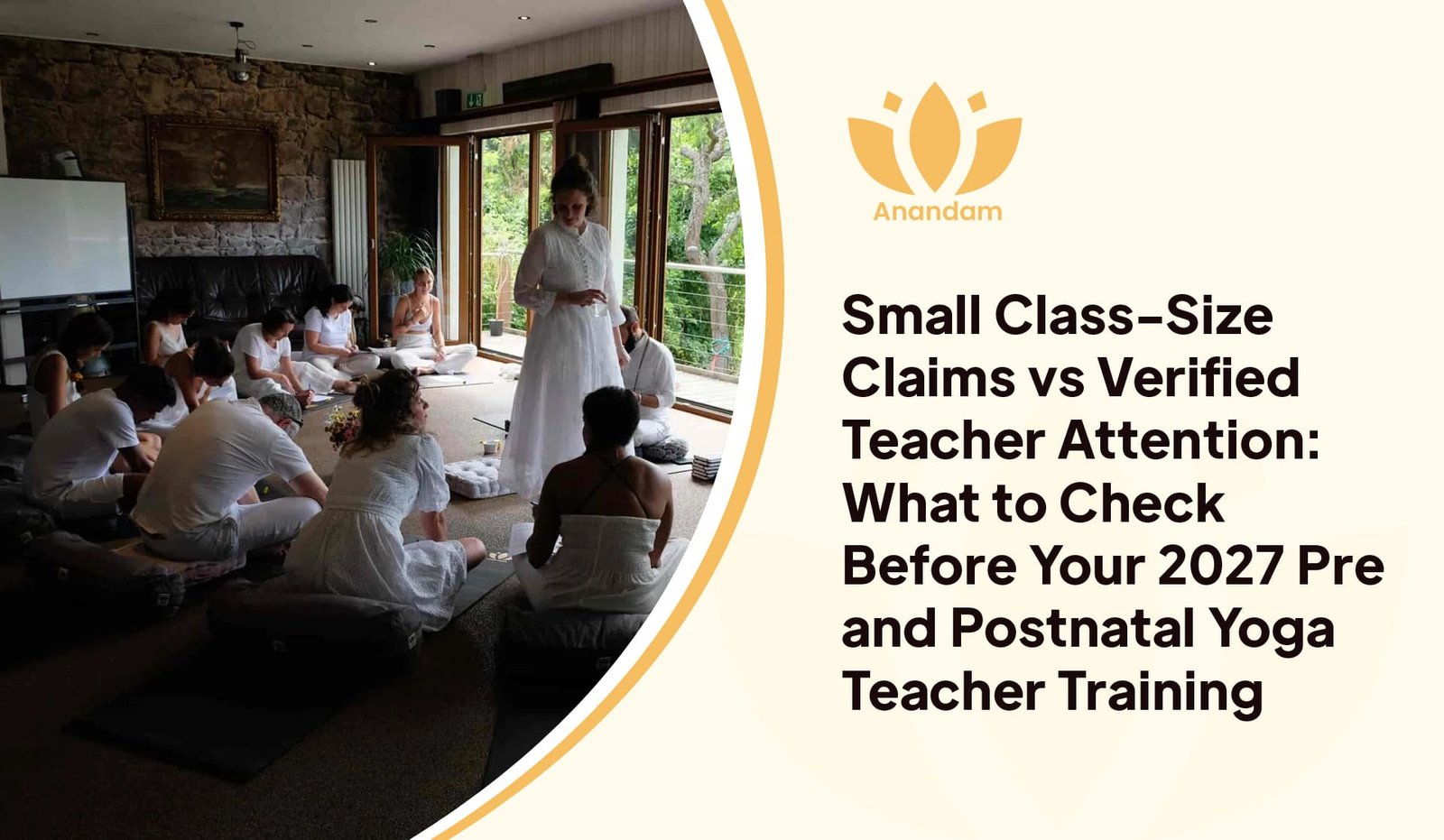
Anandam Yoga School's 100-Hour Pre and Postnatal Yoga Teacher Training in Germany is led by Yogi Sandeep Atri, E-RYT 500 and holder of an M.A. in Yoga and Yoga Therapy from Uttarakhand University, and Dr. Katharina Austermann, E-RYT 500 and PhD in Nutrition and Food Science from the University of Bonn, who has contributed to an ESA-affiliated research study on bone metabolism. Both are named, both are present for the full residential period in Heimbach, in Germany's Eifel region, and both teach the hands-on adjustment and feedback sessions directly rather than handing them to assistants.
“We deliberately keep our courses smaller than other schools, because for us personal attention matters. We want to know whom we are teaching and build genuine connections. It is a more family-like environment where questions are welcome and part of the learning process.”
That is the real differentiator, not the number on the enrollment cap page. The confirmed Nov 20 to 29, 2026 intake runs this model at EUR 2,700 for a shared twin room or EUR 2,900 for a private double, both inclusive of accommodation, meals, study materials, and certification.
Why This Matters Medically, Not Just Pedagogically
This is not just a teaching-quality preference. Exercise guidance during pregnancy and the postpartum period is genuinely individual: the American College of Obstetricians and Gynecologists notes that exercise recommendations during and after pregnancy should be tailored to the individual, accounting for trimester, any pregnancy complications, and recovery from delivery (acog.org/womens-health/faqs/exercise-during-pregnancy).
A training environment that cannot give you that kind of individualized attention during the course itself is unlikely to teach you how to give it to your own future students either.
What to Actually Verify Before You Book
If you are weighing Anandam against a larger or more marketing-forward school, you do not need to take either school's word for the attention claim. Ask directly for the lead instructor's name and credential for the pregnancy-specific modules, ask whether that person is present for the whole residential period, and ask how a hands-on adjustment session actually runs. If a school cannot answer those three questions clearly, the class-size number on its homepage is not telling you what you think it is telling you.
For a closer look at who is actually teaching at Anandam, the Teachers page lists both instructors' full credentials. If you want to understand how the November intake's qualification and booking process actually works, the guide on who can join the Pre and Postnatal training in Germany walks through eligibility and the deposit process step by step, and the comparison of residential versus studio-based formats covers a related but different decision: whether you want a live-in immersive week at all, separate from who is teaching it.
Frequently Asked Questions
Does a smaller class size guarantee more individual attention in a pre and postnatal yoga teacher training?
Not by itself. A capped headcount limits how many people can enroll, but it says nothing about how many qualified lead instructors are actually teaching, whether they are present for the full program, or how feedback is delivered. The ratio of named, present instructors to students matters more than the enrollment cap alone.
What should I ask a school before trusting its "small class size" marketing?
Ask for the name and specific credential of the instructor teaching the pregnancy-specific and postpartum-specific modules, whether that person is present for the entire residential period, and how hands-on feedback is actually delivered during practice sessions.
Why does class size matter more for pre and postnatal training than for a general 200-hour program?
Pre and postnatal students are not interchangeable. A first-trimester student, a third-trimester student, and someone recovering from a cesarean section need different modifications on the same day, so the training needs enough qualified, present instructor attention to catch and correct for those differences individually, not just a lower headcount.
What are the real dates and pricing for Anandam's Pre and Postnatal Yoga Teacher Training in Germany?
The confirmed intake runs November 20 to 29, 2026, in Heimbach, Germany. Pricing is EUR 2,700 for a shared twin room or EUR 2,900 for a private double, both including accommodation, meals, study materials, and certification.
Are Anandam's instructors present for the whole course, or do they rotate out?
Both lead instructors, Yogi Sandeep Atri and Dr. Katharina Austermann, are present for the full residential period and teach the hands-on adjustment and feedback sessions themselves rather than delegating them to assistants.
Is this training open to people who are not planning to teach, just to deepen their own pregnancy or postpartum practice?
Yes. The training welcomes students who want to deepen their personal practice as well as those pursuing teaching certification, though a separate 200-hour credential is required if you intend to teach pre and postnatal yoga professionally under most accrediting bodies.