
Written by
M.A. Yoga and Yoga Therapy, Uttarakhand University · Founder, Anandam Yoga School · Direct descendant of the Rishi Atri lineage
June 2026 · 12 min read
Quick Answer
Online yoga teacher training earns you the same Yoga Alliance RYT 200 certification as a residential program. On paper, they are equal. In practice, they are not. The certification question and the teacher quality question are two different questions, and most articles answering this topic combine them. This article separates them honestly. Online training is the right choice for certain students in certain situations. A fully residential immersive program produces something online training cannot replicate: embodied teaching competency developed over 21 consecutive days of living, eating, and practicing with the same teachers and students.
Anandam Yoga School – 200-Hour Residential Yoga Teacher Training 2026
Germany (Aug 24-Sep 13) from EUR 3,900 early bird · Bali (multiple batches) from EUR 1,600 early bird
Maximum 15 students · Same lead teachers at every location
Why Most Articles on This Topic Get It Wrong
I want to be honest about something before going further. I run a residential yoga teacher training school and I have a clear position in this debate. You should know that when reading this article, and weigh it accordingly.
What I can offer that most articles on this topic cannot is 10 years of watching what happens to teachers after they graduate from different formats. I have taught alongside teachers who trained online. I have had students arrive at our advanced 300-hour program having completed their 200-hour training online. I have seen where that preparation is strong and where it falls short. I am not interested in dismissing online training because it competes with what we offer. During Covid-19 we also offered trainings online. I am interested in giving you the most honest picture I can of what each format actually offers.
So let me start with the thing online training schools get right, and then get specific about what they understate.
“Yoga is not primarily information. It is transmission. The question is not whether you can learn the content online. It is if just content is what a yoga teacher training is actually for.”
– Yogi Sandeep Atri, E-RYT 500, Founder, Anandam Yoga School
What Online Training Does Well – Genuinely
Online training schools make several legitimate points that I agree with entirely.
The certification is identical. A Yoga Alliance RYT 200 from an online Registered Yoga School is the same credential as an RYT 200 from a residential school. Studios, hospitals, corporate wellness programs, and gyms in most markets do not ask how your training was delivered. They ask if you are registered with Yoga Alliance. If you are, you meet the basic standard. This is true and should not be minimized.
The content is accessible. Anatomy, philosophy, pranayama theory, sequencing principles – these can be taught effectively in an online format. A well-designed online program with clear video instruction, structured assessments, and access to qualified teachers for questions can deliver the cognitive content of a 200-hour curriculum rigorously. Some online schools have invested significantly in this and the result is genuinely good content delivery.
The cost and flexibility advantages are real. Online programs typically cost between USD 400 and USD 3,500 versus USD 3,000 to USD 8,000 or more for residential programs once travel and accommodation are included. For students with family commitments, job constraints, or financial limitations, this is not a minor consideration. It is often the difference between being able to train at all or not.
For students who do not intend to teach professionally, online training may be entirely appropriate. A significant proportion of yoga teacher training students enroll for personal development rather than professional certification. For those students, the depth of embodied teaching competency matters less than the breadth of content and philosophy they absorb. Online training can serve this purpose well.
What Online Training Cannot Replicate – The Honest Specifics
Here is where I need to be precise, because there is a gap. There are specific things that happen in a residential immersive environment that do not happen in online training, and they are the things that most directly determine teaching quality.
Supervised Teaching Practice Under Real-Time Correction
In our 21-day Germany program, students begin supervised teaching practice on Day 2. Over the course of the training, each student completes 12 to 15 hours of supervised teaching – more than double the Yoga Alliance minimum. They teach in front of their peers and in front of me and Katharina. We observe, interrupt, correct, and guide.
The quality of feedback available in this format is categorically different from what online programs can provide. An online teacher watching a recording of your teaching can give you written feedback and can schedule a video call to discuss it. What they cannot do is stand behind you while you cue a student into a forward fold and say “your voice dropped when you got to the alignment instruction, not everyone could hear you.” That only happens in person and it happens fast, because the environment creates dozens of micro-corrections per session.
Most online programs offer 6 to 10 peer teaching hours, typically over Zoom, with written feedback or verbally after teaching the class. None that I have encountered offer anything close to what 21 days of daily supervised practice in the same room provides.
The number of hours is only part of the design. See how daily micro-teaching, feedback, reteaching and a final practicum reveal different aspects of teacher readiness.
Hands-On Adjustments and Tactile Teaching Skills
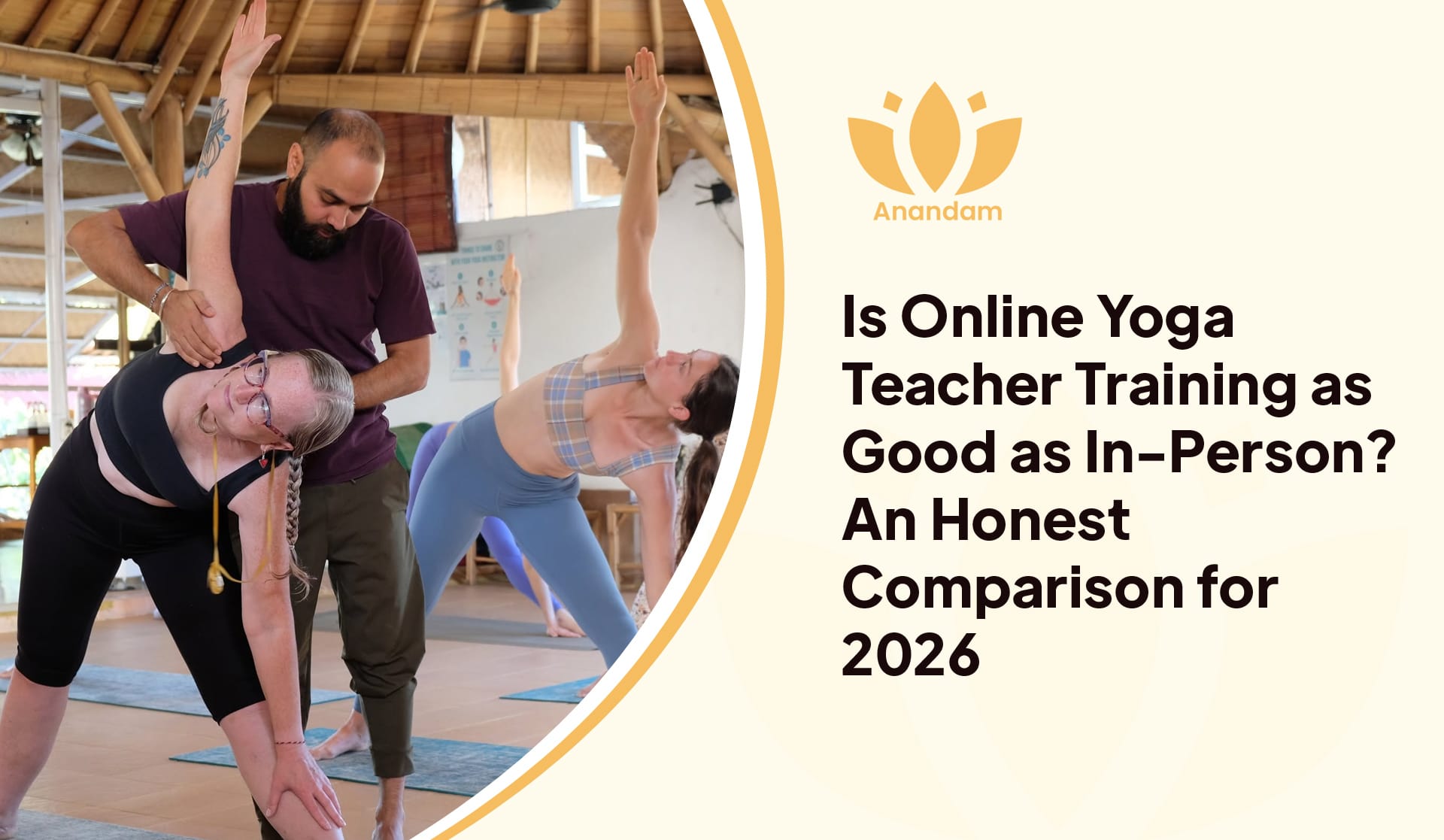
Hands-on adjustments cannot be meaningfully learned through a screen. You can watch demonstrations online and can discuss principles and contraindications. You can even practice on family members at home. What you cannot develop is the tactile sensitivity that comes from working with many different bodies under direct supervision.
In our Germany training, students practice hands-on assists throughout the course while receiving immediate feedback from experienced teachers. We can observe where pressure is being applied, how a student approaches another person’s body, whether an adjustment feels supportive or intrusive, and whether the intention matches the actual effect. These are details that often become obvious within seconds in person but are largely invisible through a webcam.
Most online programs either omit hands-on adjustments entirely or teach them as a theoretical subject. For students who intend to teach in-person classes, there is a meaningful difference between understanding an adjustment conceptually and developing the practical skill to apply it safely, respectfully, and effectively with real people.
The Embodied Experience of Being a Student in a Physical Class Over Time
Teaching yoga requires understanding what it feels like to be in a student’s body over a sustained period of practice. Days and weeks of consistent practice with the same teacher, in the same space, with the same group.
This is where something shifts that I find very difficult to explain in words but that every teacher recognizes. You start to feel what a class feels like from the inside – the difference in how students receive a cue at 8am versus 5pm, how the energy of the room changes on a rainy day, how one student’s struggle with a pose affects the group dynamic, how silence lands differently than words at different moments in a class.
This is not information and you cannot learn it from a recording. It is experiential knowledge that comes through physical presence over time. Online training, by definition, does not provide it.
Lineage Transmission
I come from the Rishi Atri tradition, one of the seven Saptarishi lineages of ancient India. I was trained from childhood by my family within this tradition. When I teach, I am transmitting not just information but a way of being in yoga that came to me through my parents and grandparents as it came to them through theirs.
This transmission cannot happen through a screen. It requires physical presence. It requires sharing a practice space over time and the kind of sustained attention that only happens when two people are in the same room, practicing together, for weeks.
I recognize that not all online teachers lack lineage and not all residential teachers have it. The question of lineage is separate from the question of format. But the transmission of lineage – whatever that lineage is – is inherently physical. It happens in person.
The Community of Shared Experience
A residential cohort develops a bond that becomes a professional and personal network for life. Students who spend 21 days together, waking up at 6am for shatkarma, eating three meals a day together, struggling through philosophy they do not yet understand, teaching each other – these students know each other in a way that online cohort members simply do not.
That network matters practically after graduation. Former cohort members become friends, refer each other for teaching opportunities, collaborate on retreats, and continue learning from each other for years. It is not something that can be manufactured through a Zoom breakout room.
A Real Example of Where the Gap Shows Up
A teacher who joined our 300-hour advanced program in Germany had completed her 200-hour certification online with a well-regarded program and so far only taught online classes. She was knowledgeable and her philosophy and anatomy understanding was good.
On her first day of teaching practice with the group, she knew the sequence she was supposed to guide. But she did not yet know how to position herself in the room when stepping from her mat or when to give more space and when to offer support. She also did not have any experience with hands-on adjustments.
Within a week of daily supervised practice in our residential setting, she had made more progress on these dimensions than she had in the previous 12 months of online teaching. She told us this herself.
The Five Specific Differences – A Practical Comparison
| Factor | Residential (Anandam) | Online Program (Typical) |
|---|---|---|
| Teaching practice hours | 12 to 15+ hours over 21 days with consistent lead teacher observation and real-time correction | Typically 6 to 10 hours, often peer-to-peer over Zoom, feedback frequently asynchronous |
| Hands-on adjustment skills | Practical experience developed through direct practice, supervision, and immediate feedback with real people throughout the training | Principles and techniques learned theoretically through demonstrations and discussion, or completely absent |
| Embodied learning | 2 to 3 hours of daily guided practice with the same teachers and peers for 21 consecutive days | Theoretical understanding developed through structured content. Physical practice done independently at home |
| Community and cohort | Shared physical space for 21 days. Deep bonds developed through lived experience | Cohort community built through live sessions and online forums |
| Lineage transmission | Transmission is possible when the teacher has genuine lineage and is present | Content can reflect lineage but transmission of lineage requires physical proximity |
| Time to confident teaching after graduation | Most graduates feel ready to lead a class within weeks. Supervised teaching hours compress the confidence-building curve significantly | Often requires 6 to 12 months of regular local teaching before feeling genuinely confident leading a class independently |
Who Should Choose Online Training
I want to be genuinely useful here rather than dismissive, so let me be specific about when online training is the right choice.
Choose online training if: you have significant family or work commitments that make 21 consecutive days away genuinely impossible. You are training primarily for personal development rather than professional teaching. Your budget does not allow for the additional cost of residential training and travel. You live somewhere with no accessible residential training within reasonable travel distance. You want to deepen your knowledge in a specific area and are adding to an existing credential rather than building a foundation.
Choose residential training if: you intend to teach professionally and want to be ready quickly. You want the embodied learning that comes from physical immersion. You are at the beginning of your yoga journey and want the full depth of what the tradition has to offer, not just the curriculum. You want a cohort community that will support you after graduation. You want the transmission of a living tradition from a teacher with genuine lineage.
What to Ask Any Online Program Before Enrolling
If you do choose online training, these questions separate programs that deliver real preparation from those that deliver a certificate.
How many live teaching practice hours are included, and who gives feedback? If the answer is fewer than 8 hours of supervised teaching with feedback from a qualified teacher, the program is not adequately preparing you to teach.
Are there live sessions with the lead teacher, or is the program entirely pre-recorded? A fully pre-recorded program can deliver content but it cannot respond to you. If the lead teacher never interacts with you directly, you are not being trained by them but are consuming their content.
What is the lead teacher’s background and how long have they been teaching? Teaching yoga online since 2015 is different from teaching yoga since childhood in a family tradition. Both can be legitimate and you should know which one you are choosing.
What do graduates say about their first year of teaching? Not about the training itself but about what happened after. Whether graduates are actually teaching, how confident they felt in their first classes, and how prepared they were for the reality of leading a live class.
What is the actual Yoga Alliance registration? Confirm the school is an RYS, not just marketing Yoga Alliance affiliation. Check the school directly on yogaalliance.org before enrolling.
The Honest Bottom Line
Online training is legitimate and the certification is real. For certain students in certain situations it is the right choice.
It does not produce the same depth of embodied teaching competency as a well-run 21-day residential program with consistent lead teacher presence and 12 to 15 hours of supervised teaching practice. That is not an opinion. This is my observation after training teachers both ways and observing the difference.
If your question is “will I have an RYT 200?” the answer is the same for both formats. If your question is “will I be ready to confidently lead a live class of diverse students in my first month after graduation?” the answer is not the same.
Anandam Yoga School – 200-Hour Residential Teacher Training
21 days · 12 to 15 hours supervised teaching practice · Maximum 15 students
Germany Aug 24-Sep 13, 2026 from EUR 3,900 early bird · Bali multiple batches April-August 2026 from EUR 1,600 early bird
Frequently Asked Questions
Is an online yoga teacher training certificate recognized by yoga studios?
Yes. A Yoga Alliance RYT 200 from an online Registered Yoga School is recognized by studios, gyms, and wellness centers in the same way as an RYT 200 from a residential school. The credential does not specify how the training was delivered.
How many teaching practice hours should an online yoga teacher training include?
A minimum of 8 supervised live teaching hours with qualified teacher feedback. Programs offering fewer than this are not adequately preparing students for the reality of leading a live class. Strong programs offer 10 to 15 hours. Residential programs at the higher end of quality typically offer 12 to 15 hours.
Can you become a good yoga teacher through online training?
Yes, with effort and sustained local practice after graduation. Online training gives you the knowledge and becoming a good teacher requires accumulating teaching hours in person with real students after graduation. This happens faster after a residential program because supervised teaching hours are concentrated in the training itself rather than spread across months of post-graduation local teaching.
What is the main thing missing from online yoga teacher training?
Real-time supervised teaching practice and the development of hands-on teaching skills under the consistent observation of an experienced teacher. The feedback that shapes teaching competency fastest is the correction that happens in the moment and same room, while you are teaching or working directly with another student. Asynchronous video feedback is valuable but it is slower and less precise. Likewise, hands-on adjustments can be explained online but the tactile sensitivity, confidence, and judgment required to apply them safely are developed through direct practice and immediate feedback in person.
How long does it take to feel ready to teach after online vs residential training?
After online training, most graduates report needing 6 to 12 months of regular local teaching before feeling genuinely confident in leading a class independently. After a well-run residential program with substantial supervised teaching hours, most graduates feel ready within a few weeks. The difference is in the density and quality of supervised teaching practice during the training itself.
Is the Yoga Alliance RYT 200 the same regardless of how training was delivered?
Yes. Yoga Alliance does not distinguish between online and in-person delivery in the RYT 200 credential, provided the school is a Registered Yoga School.
Does residential training have any disadvantages compared to online?
Yes. Higher total cost, requirement for 21 consecutive days away from regular life, need to travel to the location. For students with significant family commitments, financial constraints, or limited time availability, these are real barriers that online training does not create. The choice of format should reflect your actual situation, not an abstract preference for one over the other.
Can I complete a 200-hour online training and then do an advanced 300-hour residential program?
Yes. We have had students do exactly this. What we consistently observe is that students with a residential 200-hour foundation develop faster in the advanced program than those with an online foundation. The gap can be closed with sustained local teaching experience after online training, but it requires intentional effort.
Ready to Train Residentially?
Anandam Yoga School – Same Lead Teachers at Every Location
Germany: Aug 24-Sep 13, 2026 from EUR 3,900 early bird (20 nights + breakfast) · Bali: Multiple batches from EUR 1,600 early bird
Related Reading
- → Are Anandam Yoga School’s European Retreats Competitive with Top German Retreat Centers?
- → Best Yoga Teacher Training Programs Worldwide 2026
- → 200-Hour YTT Germany – What to Expect Day by Day
- → Anandam vs Other European Yoga Schools – Honest Comparison
- → How Much Does Yoga Teacher Training Cost in Europe 2026