100-Hour Arm Balancing Yoga Teacher Training 2026 – Germany & Bali | Complete Guide
- Anandam Yoga
- Last Updated: September 4, 2026
By Yogi Sandeep Atri, E-RYT 500 | April 21, 2026 | 10 min read
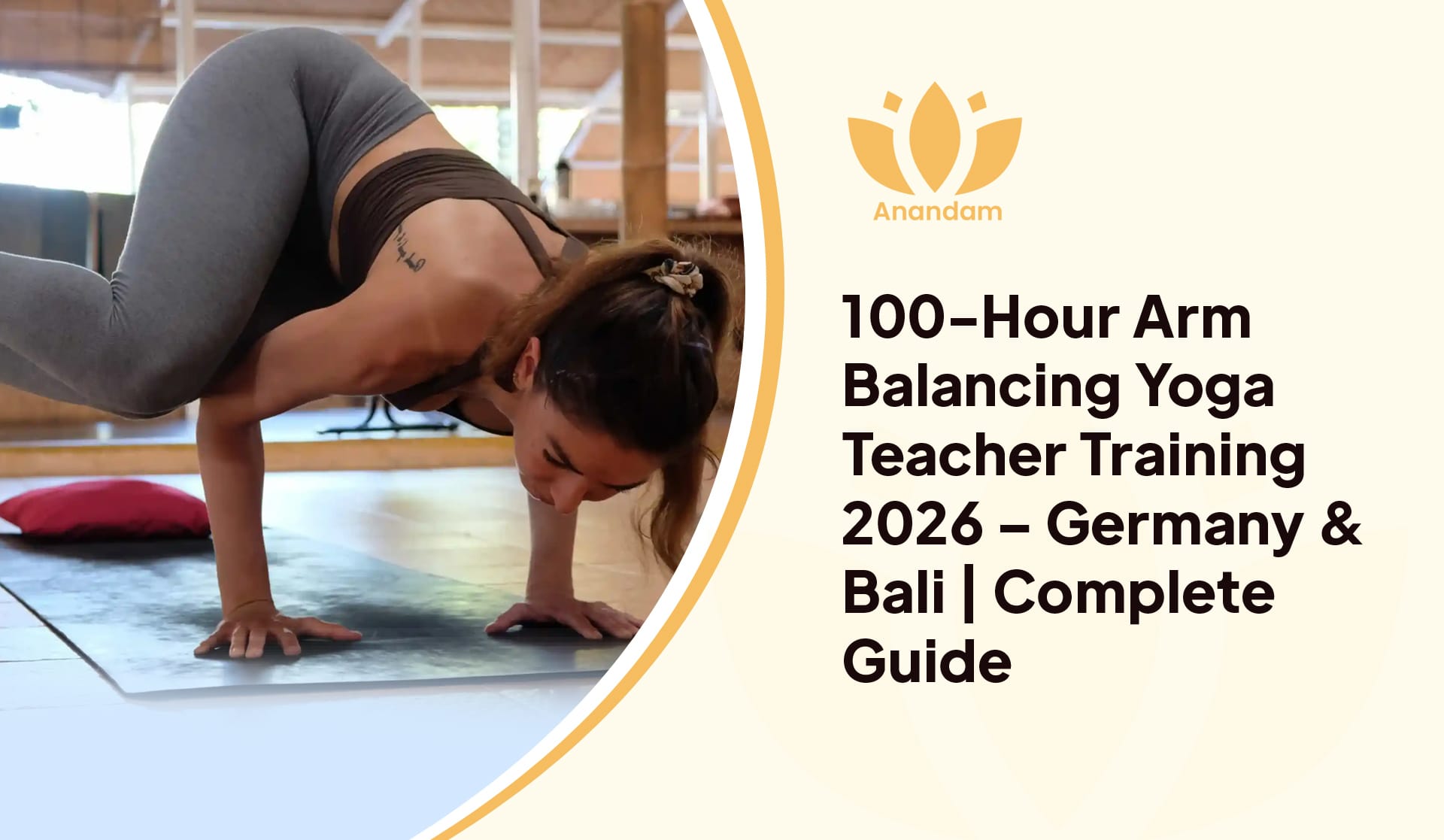
A 100-hour arm balancing yoga teacher training is a specialist certification that teaches yoga practitioners the biomechanics, technique, and pedagogy of arm balances and inversions — from foundational Crow Pose through Handstand and Forearm Stand. In Germany, Anandam Yoga School offers a 100-hour arm balancing teacher training at Heimbach in the Eifel National Park, in three 2026 batches: July 6–15, November 3–12, and November 20–29. The training is YACEP-certified, open to yoga teachers and experienced practitioners, and runs as a 10-day residential programme. Price: €2,200 including accommodation and breakfast. The same training is also available in Bali (Canggu) throughout the year.
Arm balances are the poses that most yoga teachers feel least confident teaching — and most students feel least confident attempting. The fear of falling, the uncertainty about what the body needs to do, the lack of a clear progression from beginner to advanced: these are not personal failures. They are the result of training programmes that demonstrate arm balances without actually teaching the underlying mechanics.
This guide covers what a proper arm balancing teacher training involves, why the biomechanics approach changes everything, what Anandam's programme at Heimbach and Bali covers, and who this training is genuinely for.
Why Arm Balancing Requires Specialist Teacher Training
Most yoga teacher trainings include arm balances in the asana curriculum — but "including" typically means demonstrating Crow Pose and asking students to try it. That is not teaching arm balances; it is exposing students to arm balances. The distinction matters enormously for what your students actually experience.
Arm balances and inversions require three things that standard YTT curricula rarely address systematically: specific upper body and core strength prerequisites, an understanding of the weight shift mechanics that are counterintuitive for most bodies, and a progression methodology that builds genuine skill rather than relying on the teacher spotting students into poses they are not yet ready for.
A student who learns Crow Pose through correct mechanics — understanding where the weight needs to go, which muscles are firing, how the gaze point affects balance, what the wrists need from the floor — will generally hold it on their first independent attempt. A student who learns by being spotted into it may never develop independent stability because they have never experienced the correct muscular engagement pattern.
The teacher training exists to give you that understanding — and the ability to transmit it.
This decision-making responsibility is why arm balancing usually benefits from a longer specialist format. Our 50-hour vs 100-hour yoga teacher training guide compares when a short module can support one carefully taught skill and when 100 hours is more proportionate for workshops, multiple pose families, and mixed-ability students.
What Anandam's 100-Hour Arm Balancing Training Covers
Biomechanics and Upper Body Anatomy
The training opens with a thorough grounding in the anatomy that matters for arm balancing: shoulder girdle mechanics, wrist loading and safety, core engagement patterns (how the deep abdominals and hip flexors work in arm balances, not just the superficial abs), the role of the bandhas in creating internal support, and how different body proportions affect which arm balances are accessible and at what stage.
The Arm Balance Poses — Full Spectrum
The curriculum progresses systematically through the full arm balance family:
- Foundation poses: Plank variations, Chaturanga mechanics, Downward Dog wrist work, core activation drills
- Entry arm balances: Crow Pose (Kakasana), Crane Pose (Bakasana) — the distinction between these two matters for teaching progressions
- Lateral arm balances: Side Crow, Koundinyasana I & II, Eight Angle Pose (Ashtavakrasana), Firefly Pose (Tittibhasana)
- Inversions: Tripod Headstand, Supported Headstand, Shoulderstand, Handstand (wall-assisted and freestanding progressions), Forearm Stand (Pincha Mayurasana)
- Advanced: Flying Pigeon, One-Legged Crow, arm balance transitions and flows
Teaching Methodology and Student Psychology
A significant portion of the training addresses the psychology of teaching arm balances — specifically the fear and hesitation that most students bring. Understanding why students are afraid (the fear of falling forward, pain memories from wrist issues, body image concerns about placing weight on the arms) allows you to structure sequences, language, and progressions that build genuine trust before attempting the poses themselves.
Spotting, Assisting, and Contraindications
Hands-on adjustment for arm balances requires specific body mechanics from the teacher — how to spot a Handstand safely without straining your own back, how to assist Crow without encouraging the wrong weight shift, when not to spot at all. The training covers each pose's specific assist techniques and contraindications including wrist injuries, shoulder instability, hypertension, and pregnancy.
Sequencing and Programme Design
How to build a 60-minute arm balance class from scratch: warm-up requirements, the sequencing logic for shoulder, core, and hip opening as preparation, peak pose selection, counter-poses, and cool-down. Students leave with five complete ready-to-teach class plans at different levels.
100-Hour Arm Balancing Teacher Training — Germany 2026
Jul 6–15 · Nov 3–12 · Nov 20–29 · Heimbach, Eifel · YACEP · €2,200
View Germany Programme ↗Germany vs Bali — Which Location Is Right for You?
| Feature | Germany — Eifel National Park | Bali — Canggu |
|---|---|---|
| 2026 Batches | Jul 6–15 · Nov 3–12 · Nov 20–29 | Multiple dates |
| Price | €2,200 | See Bali page |
| Setting | National park, forest, silence | Tropical, rice fields, beach nearby |
| Best for | European-based teachers, focused immersion | Combined holiday + training, international cohort |
| Lead teacher | Yogi Sandeep Atri | Yogi Sandeep Atri |
Who Is This Training For?
The arm balancing teacher training attracts three main groups.
Yoga teachers who avoid teaching arm balances because they don't feel confident in their own understanding — this is the majority. If you currently skip Crow Pose in your sequences or feel anxiety when a student asks about Handstand, this training is precisely designed for you. You do not need to be an arm balance practitioner yourself to become an excellent arm balance teacher — you need a clear understanding of the mechanics and progressions.
Intermediate-to-advanced practitioners who want to deepen their personal arm balance practice with a biomechanical understanding, not just more repetitions. Many students in this group discover, during the training, that what they thought were strength limitations were actually technique misunderstandings — and make more progress in 10 days than in years of regular practice.
Teachers adding a specialist credential to their portfolio. As the yoga market becomes more differentiated, specialists consistently earn more and attract more committed students than generalists. An arm balancing specialist certification from a YACEP provider opens access to workshops, corporate bookings, and private teaching that general yoga teaching doesn't.
YACEP Certification and Continuing Education
The 100-hour arm balancing training at Anandam is YACEP-certified through Yoga Alliance. For current RYT 200 or RYT 500 holders, the 100 hours count toward continuing education renewal — covering more than three full renewal cycles of 30 hours each. For more information on how YACEP continuing education works in Germany, see the YACEP continuing education guide for Germany 2026.
Frequently Asked Questions
What does the training cover?
Biomechanics and upper body anatomy, the full arm balance pose family from Crow to Handstand and Forearm Stand, teaching methodology, student psychology, spotting techniques, contraindications, and class sequencing. Students leave with 5 complete ready-to-teach class plans.
Do I need to be able to do a handstand already?
No. The training covers the full progression from foundational preparation through advanced inversions. The focus is on understanding mechanics and teaching them — not on demonstrating a perfect handstand.
Where does the Germany training take place?
Heimbach, Eifel National Park — 30 minutes from Aachen, 1 hour from Cologne. Three batches in 2026: July 6–15, November 3–12, November 20–29.
What does it cost?
€2,200 for the 10-day residential Germany programme, including accommodation and daily breakfast.
Does it count as YACEP continuing education?
Yes. 100 YACEP hours — covering more than three full Yoga Alliance renewal cycles for RYT holders.
Is it suitable for teachers who don't teach advanced students?
Absolutely. The training is especially valuable for teachers whose classes include beginners and intermediate students — because it gives you the progressions and language to bring arm balancing into any level of class, starting from wall-supported Plank and building safely from there.
Arm Balancing Teacher Training — Germany & Bali 2026
100 hours · YACEP · Germany from €2,200 · Three batches in Eifel
Germany — View & Enrol ↗ Bali — View Programme