
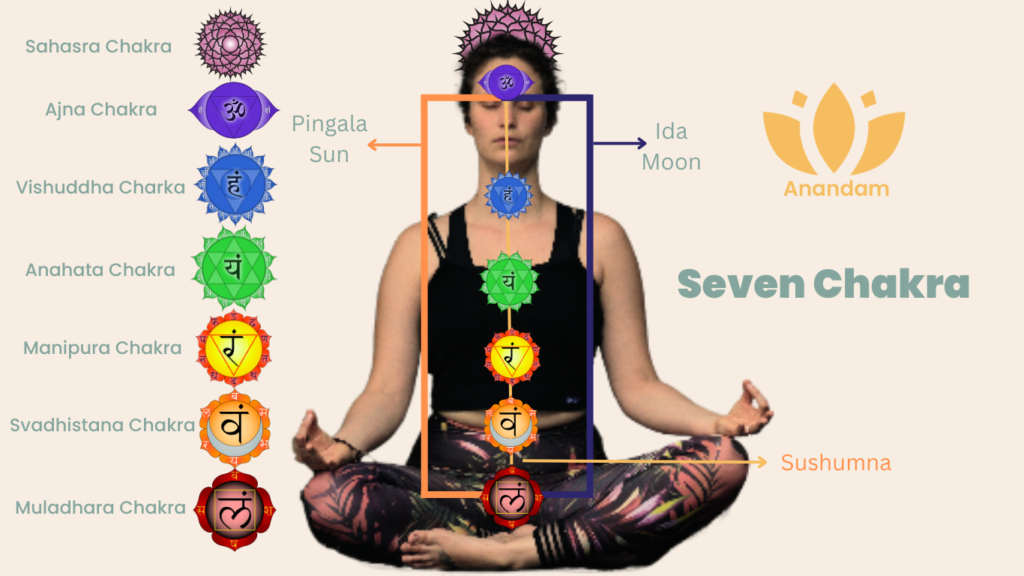
What are Chakras in the Human Body?
The Sanskrit word “chakra” can be translated as “wheel” and refers to an energy point in the body. You can imagine them as spinning wheels or discs of energy. They are junction points where the different nadis (energy channels) meet and represent a connection between our physical and astral (energy) body. The main seven chakras run along the spine located at the major branchings of the human nervous system, beginning at the base of the spinal column and moving all the way up to the top of the skull.
These energy centers play a central role in yoga philosophy, meditation, and subtle anatomy, which are core subjects taught in a comprehensive Yoga Teacher Training program. In structured courses such as the RYT 200 Certification, This deep energetic knowledge is a pillar of the best yoga teacher training in Europe, ensuring graduates can lead truly transformational classes, students learn how chakras correspond to nerve ganglia, glands, body functions, states of consciousness, and different stages of human development.
The chakra system is a complex and ancient energy framework first mentioned in the Vedas. For overall well-being, it is essential that the chakras remain open and balanced. However, modern lifestyles often create energetic blockages, leading to physical, emotional, and mental disturbances.
Pranayama and yoga postures are particularly effective in rebalancing and stimulating the chakras. This is why chakra-focused practices are deeply integrated into Yoga Teacher Training curriculam, especially in immersive programs such as Yoga Teacher Training in Bali, where spiritual awareness and energy work are practiced in depth.
The Chakras and the Nadis
Prana, our life force flows through the body in subtle energy channels or pathways known as nadis. These nadis are like roads within the body’s energy highway system. Where two or more roads cross, energy junctions form. These are the chakras. The seven major crossing points are the seven major chakras, while less busy intersections form minor chakras. According to the yogic scriptures there are more than 72000 and about 114 chakras in the human body. When your energy highway is free from traffic jams, prana can travel freely. Practicing certain meditations and yoga asanas is believed to help clear any blockages so that prana can flow freely. When we practice yoga, we are seeking to clear these pathways so our energy can flow more freely. Each pose is designed to help open the energy channels and pranayama helps us to direct and increase the vital force of the 72,000 nadis in your body.
How many chakras are in the body?
Major and Minor Chakras
The seven major chakras represent significant crossing points along the body’s energy pathways, while minor chakras are formed at less busy intersections. According to yogic scriptures, there are more than 72,000 nadis and approximately 114 chakras within the human body.
Free Flow of Energy
When your energy highway is clear from traffic jams, prana, or life force energy, can travel freely throughout the body.
Clearing Blockages
Practicing certain meditations and yoga asanas is believed to help clear any blockages along these energy pathways, facilitating the unimpeded flow of prana.
Yoga Practice and Energy Flow
Engaging in yoga practice aims to clear these pathways to enable the free flow of energy. Each yoga pose is designed to open energy channels, while pranayama techniques help in directing and increasing the vital force through the 72,000 nadis in the body.
In our Yoga trainings in Bali we teach you how to incorporate the knowledge about the seven chakras in your practice and teachings. In our advanced 300 hours Yoga teacher training course you will learn how to plan Yoga classes around the seven chakras and how to use different asanas and breathing techniques to rebalance each chakra.
A quick exercise on how to experience the effects of the nadis in the physical body
There is a simple exercise you can do to experience the effect of the nadis in your physical body. For this
- Place each thumb face up about a ½ inch under each nostril
- Exhale a few times with a little more force than is natural
- Notice how your breath feels a little stronger on one side
- Repeat this process throughout the day – you will probably notice that your “stronger” side changes every couple of hours
This change in the “stronger” side you are experiencing is completely normal and reveals the change in the predominance of the left (ida) or right (pingala) nadi. Depending on your activity and the time of the day either the moon energy (ida) or sun energy (pingala) is more active.
The only time the breath flows evenly through both nostrils is during meditation, or when your body and mind are fully aligned. Then prana increases in the central channel – the sushumna. At this time, both sides of the brain are said to be completely balanced, which may help restore balance in all spheres of life. Yoga breathing exercises (pranayama) are helpful in dissolving energy blockages in the nadis and bringing life force into the sushumna.
The main seven chakras of the human body
Starting from the base of the spine, the first three major chakras deal with the external reality: how secure and stable is your life? How do you fit into your community? How you express your individuality?
Muladhara Chakra – The Root Chakra
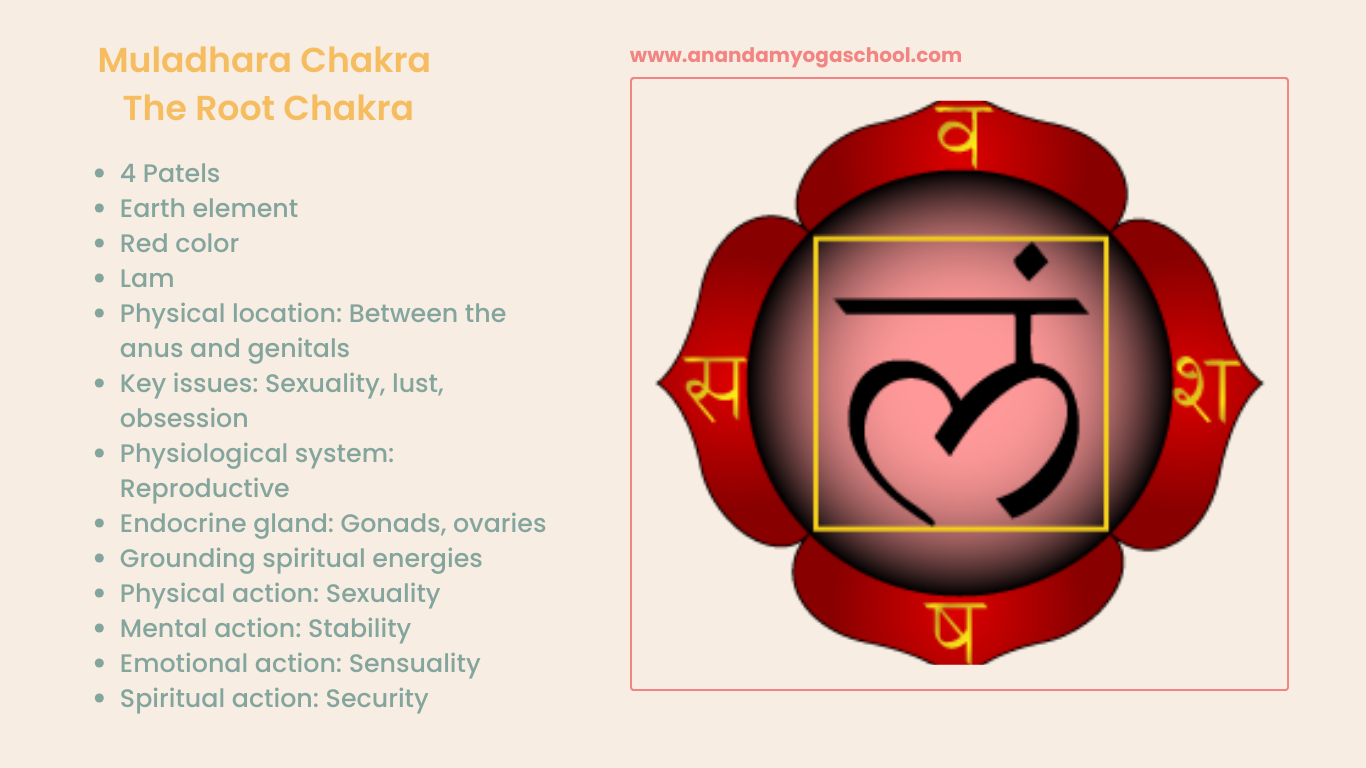
- This chakra is related to instinct, survival and security.
- It is located at the base of the spine, at the very bottom of the tailbone.
- The root chakra is symbolized by a lotus with four petals and corresponds to the color red.
- It governs stability and a sense of security.
- The beej mantra (seed mantra) to purify and stimulate the Muladhara Chakra is ‘Lam’.
- The corresponding element is earth. It helps us to recognize our strong connection to the earth and keeps us rooted and grounded.
- A few asanas to balance the first chakra: Tadasana, Vriksasana and Virabhadrasana II
Start Your Yoga Career in Germany
Transform your practice into a profession. Join our Yoga Alliance certified 200 Hour training near Munich. 2026 Batches are now forming.
Register for 200 Hour Yoga Teacher Training Germany
✨ Traditional Lineage
✨ Munich/Germany 2026
Svadhistana Chakra – The Sacral Chakra
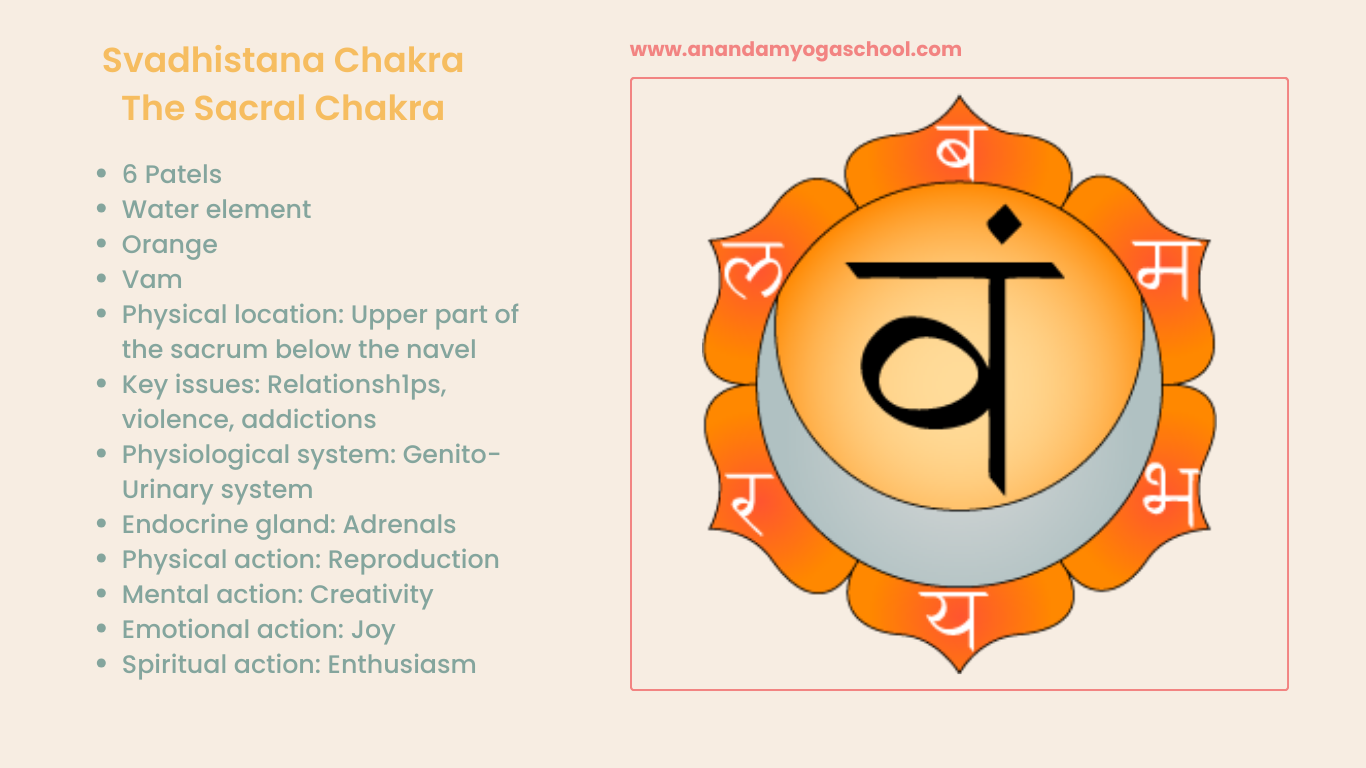
- This chakra is related to sexuality, creativity, emotions and self-worth
- It is located in the sacrum, about two inches below the navel
- The sacral chakra is symbolized by a lotus with six petals and corresponds to the color orange.
- The key issues of this chakra are relationships, as well as creativity and enthusiasm.
- Here we move beyond a focus on survival and begin to focus on our work.
- The beej mantra (seed mantra) to purify and stimulate the Svadhistana Chakra is ‘Vam’.
- The corresponding element is water. It gives us the immense power of fluidity and adaptability.
- A few asanas to balance the second chakra: Majariasana (cat pose), Balasana and Trikonasana
Manipura Chakra – The Solarplexus Chakra
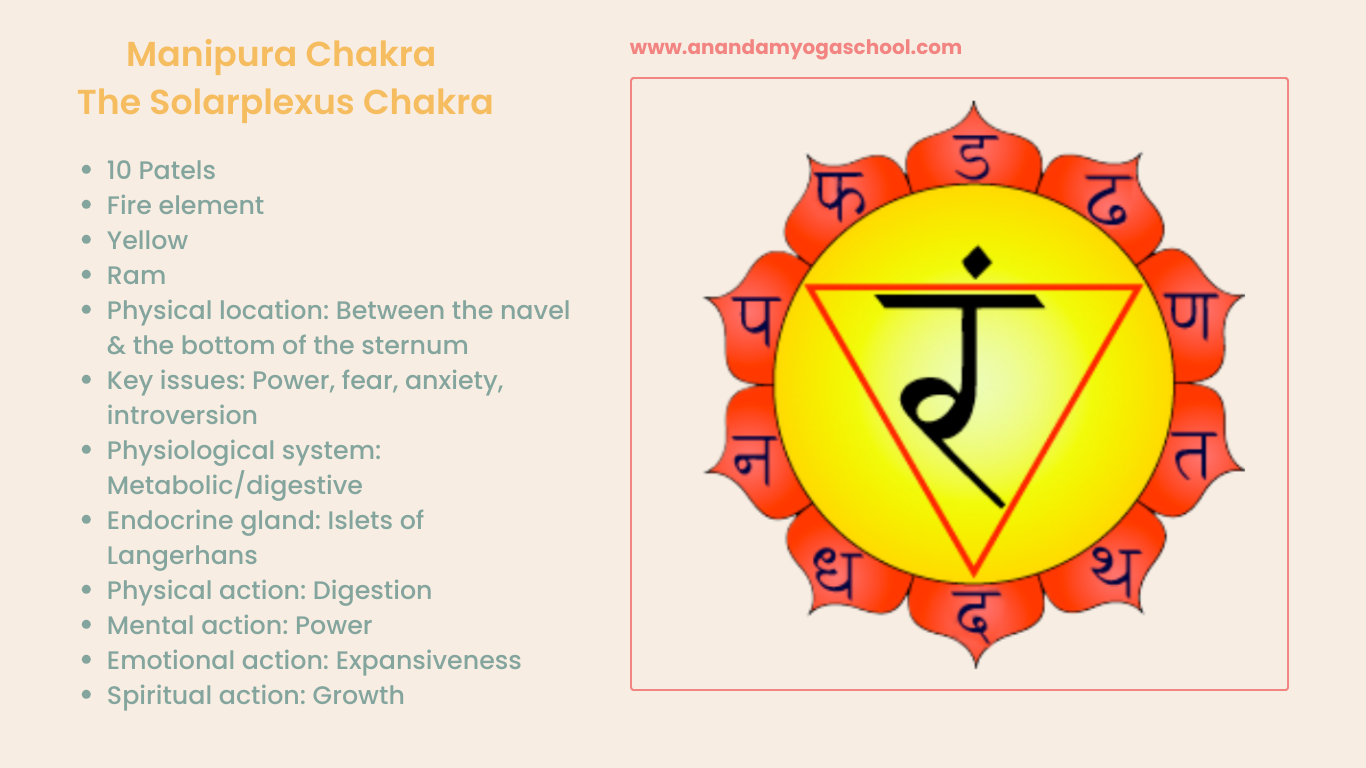
- This chakra is related to the digestive system.
- It is located just above the navel in the solar plexus region.
- The solar plexus chakra is symbolized by a lotus with ten petals and corresponds to the color yellow
- It empowers you with the energy you need to function efficiently and governs personal power.
- When in balance, it gives you a solid sense of self.
- The beej mantra (seed mantra) to purify and stimulate the Manipura Chakra is ‘Ram’.
- The corresponding element is fire. It activates the light of consciousness and motivates us to work toward success.
- A few asanas to balance the third chakra: Virasana, Navasana and Bhujpidasana
The three middle chakras deal with internal reality. They determine your self-perception, and how you express yourself and relate to others.
Anahata Chakra – The Heart Chakra
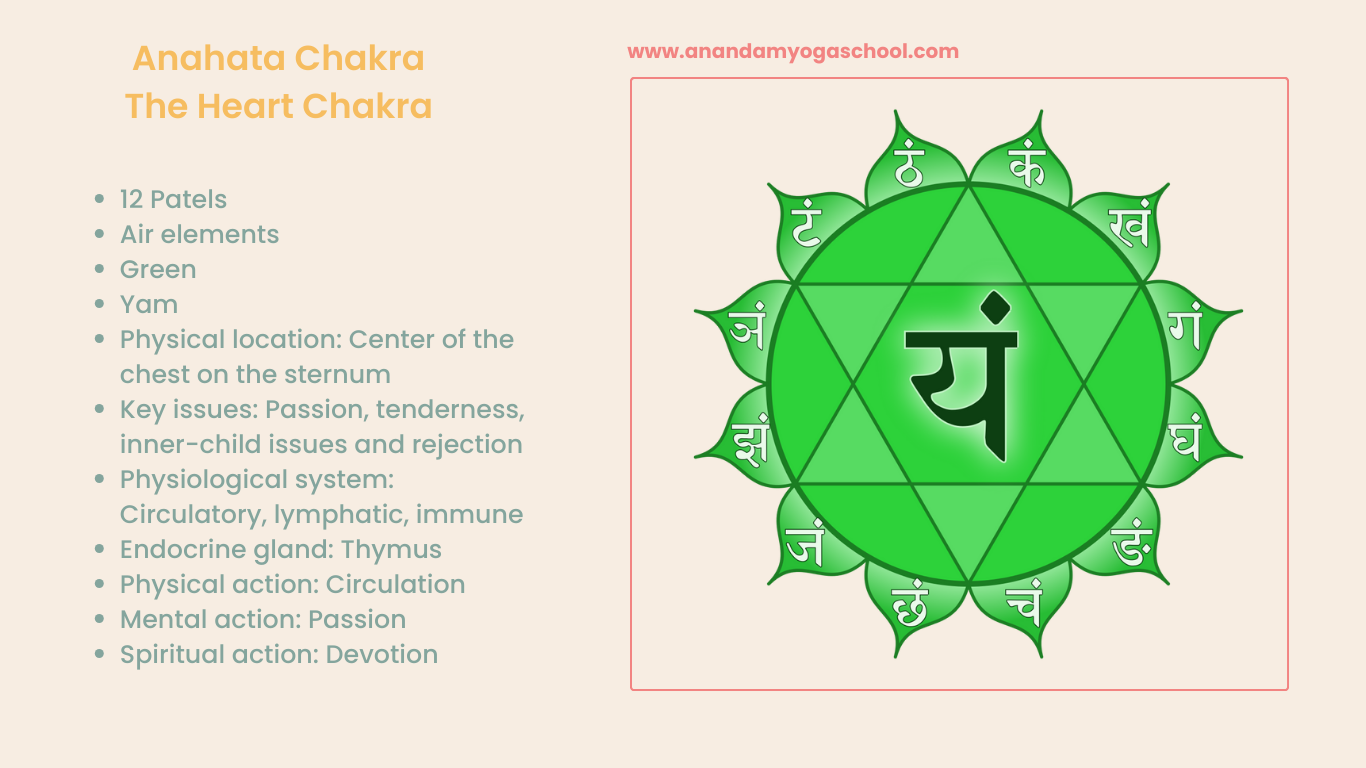
- This chakra is located in the heart region.
- It governs the energy of unconditional love and compassion, enabling you to express love, or blocking its expression.
- The heart chakra is symbolized by a lotus with twelve petals and corresponds to the color green.
- The beej mantra (seed mantra) to purify and stimulate the Anahata Chakra is ‘Yam’.
- The corresponding element is air. It helps us to expand our love and kindness.
- A few asanas to balance the fourth chakra: Bhujangasana, Setu bandhasana and Salabhasana
Vishuddha Charka – The Throat Chakra
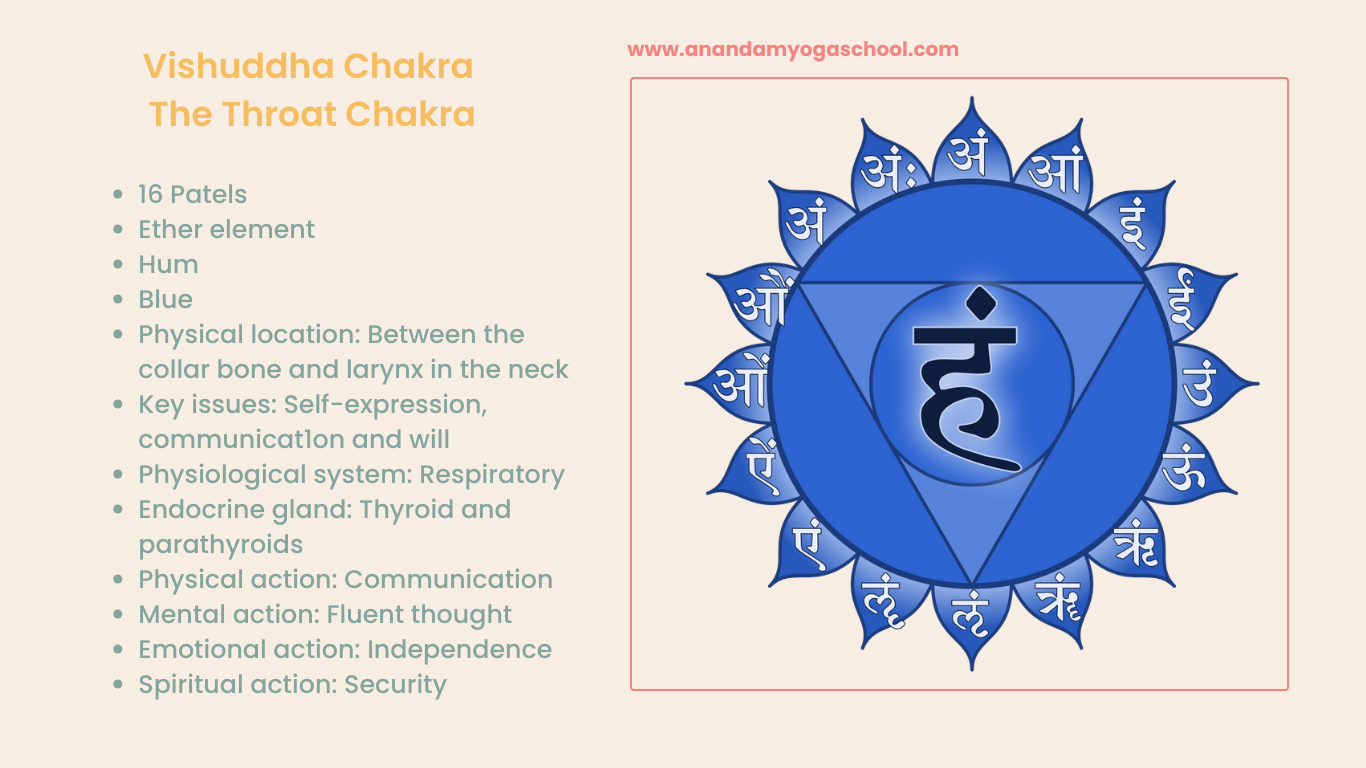
- This chakra is located in the base of our throat
- It deals with communication and allows you to take in information and express yourself with clarity and confidence.
- The throat chakra is symbolized by a lotus with sixteen petals and corresponds to the color blue.
- The beej mantra (seed mantra) to purify and stimulate the Vishuddha Chakra is ‘Ham’.
- The corresponding element is space. Space opens the possibility to expand perspective and symbolizes the energy of seeking and speaking the truth.
- A few asanas to balance the fifth chakra: Ustrasana, Halasana and Matsyasana
Ajna Chakra – The Third Eye Chakra
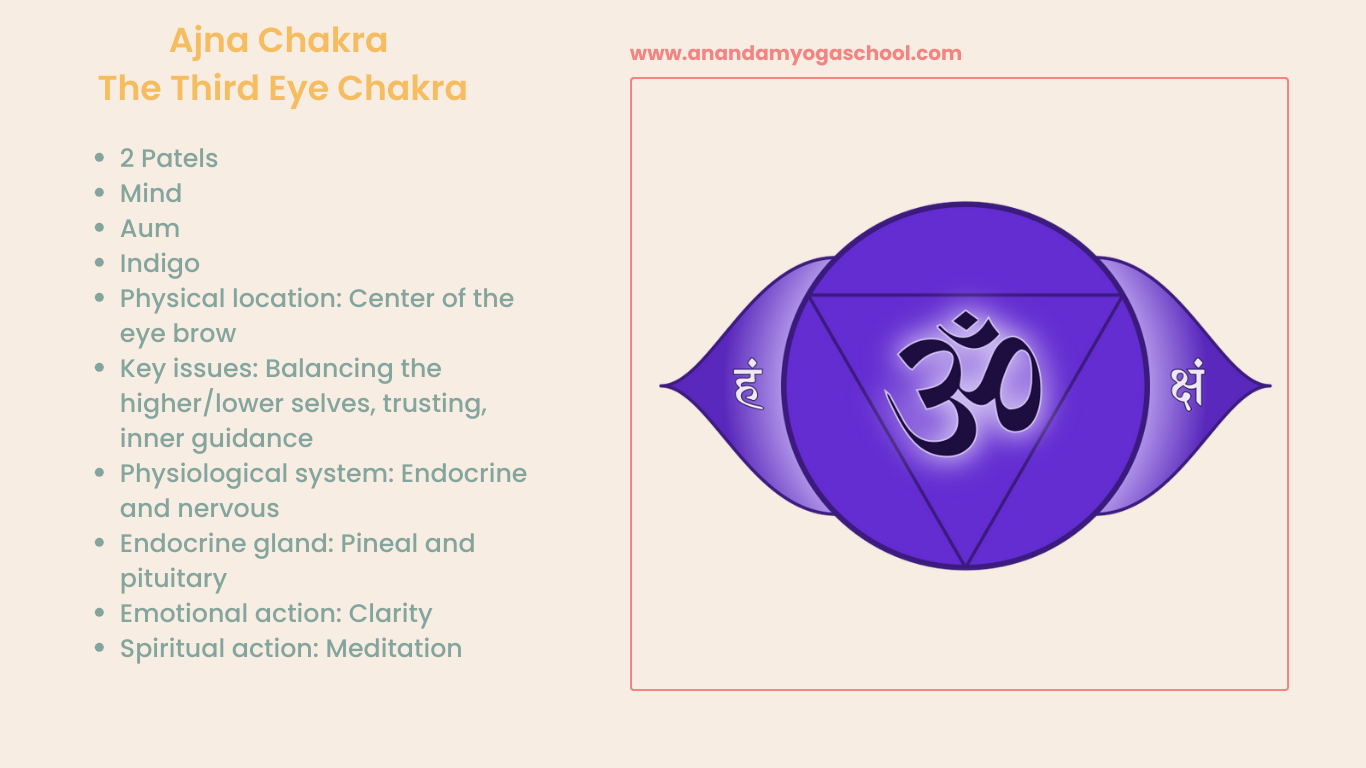
- This chakra is located between the eyebrows, at the third eye.
- It is related to your wisdom and intuition.
- Your mind’s eye sees your dreams and directs you to them.
- The third eye chakra is symbolized by a lotus with two petals and corresponds to the color indigo.
- The beej mantra (seed mantra) to purify and stimulate the Vishuddha Chakra is ‘Om’.
- The corresponding element is the mind and it is associated as seat of our intuition or our sixth sense.
- A few asanas to balance the sixth chakra: Inversions and meditative poses
The seventh Charka represents our connection to the Divine.
Sahasra Chakra – The Crown Chakra
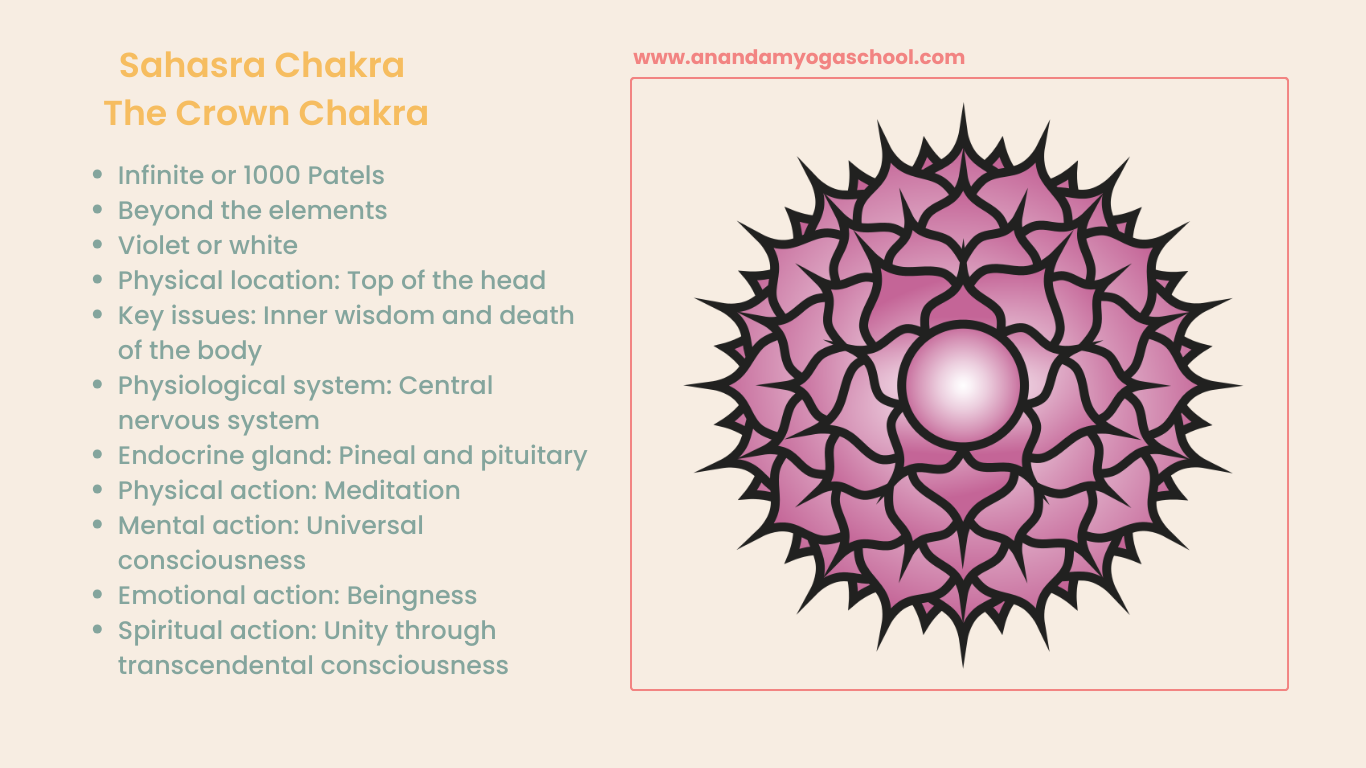
- This chakra is located at the crown of the head and is our connection to our spirituality.
- It is your highest chakra and deals with ultimate reality and infinite potential.
- The crown chakra is symbolized by a lotus with and infinite number of petals and corresponds to the color violet or white.
- The beej mantra (seed mantra) to purify and stimulate the Vishuddha Chakra is ‘Aum’.
- It is beyond the elements and symbolizes the infinite.
- A few asanas to balance the seventh chakra: Sirsasana, Matsyasana and Meditation
How can Chakras influence health?
The chakras play a vital role in influencing our overall health and well-being by serving as energetic centers that regulate the flow of life force energy (prana) throughout the body.
Energy Flow
When the chakras are balanced and the energy flows freely through them, it promotes overall vitality and well-being. However, blockages or imbalances in the chakras can disrupt the flow of energy, leading to physical, emotional, and mental health issues.
Physical Health
Each chakra is associated with specific organs, glands, and bodily functions. When the corresponding chakra is balanced, it supports the optimal functioning of those bodily systems. For example, a balanced root chakra is associated with a strong immune system and healthy bones, while a balanced heart chakra is linked to cardiac health and circulation.
Emotional Health
The chakras also influence our emotional state and psychological well-being. Balanced chakras contribute to emotional stability, self-awareness, and resilience in coping with stress and challenges.
Mental Health
The chakras are interconnected with our mental processes, including cognition, perception, and intuition. A balanced crown chakra, for instance, facilitates clarity of thought and connection to higher wisdom, while an imbalanced third eye chakra may result in confusion or mental fog.
Spiritual Health
In addition to physical, emotional, and mental aspects, the chakras are integral to our spiritual well-being. They serve as portals for spiritual growth, self-realization, and connection to higher consciousness.
How do I know if my chakras are blocked?
Blocked chakras can manifest in various physical, emotional, and mental symptoms. Here are some signs that indicate your chakras might be blocked:
Physical Symptoms
You may experience recurring ailments or chronic issues related to specific organs or areas of the body associated with each chakra. For example, blockages in the root chakra can lead to issues like lower back pain or problems with the legs and feet.
Emotional and Psychological Symptoms
Unresolved emotional issues or persistent negative emotions can indicate blocked chakras. For instance, a blocked heart chakra might result in feelings of loneliness, jealousy, or an inability to trust others.
Behavioral Patterns
Noticeable patterns in behavior, such as being overly closed off or withdrawn (indicating a blocked throat chakra) or being overly controlling or fearful (indicating a blocked solar plexus chakra), can point towards chakra blockages.
Relationship Issues
Difficulty in forming or maintaining healthy relationships may suggest blockages in certain chakras, particularly the heart and sacral chakras, which are associated with love, connection, and intimacy.
Energy Levels
A lack of vitality, persistent fatigue, or feeling lethargic might signal blocked chakras, as energy flow through the chakras is essential for maintaining overall well-being and vitality.
Creativity and Expression
Difficulty expressing yourself creatively or feeling uninspired could be indicative of a blockage in the sacral or throat chakras, which are linked to creativity and communication, respectively.
Intuition and Insight
If you find it challenging to trust your intuition or lack clarity in decision-making, it could be due to blockages in the third eye chakra, which governs intuition and insight.
Spiritual Disconnect
Feeling disconnected from your spiritual self, lacking a sense of purpose, or experiencing a lack of spiritual growth may suggest blockages in multiple chakras, inhibiting the flow of spiritual energy.
How to balance the seven chakras in the human body?
All chakras are connected and if one of them is imbalanced, it causes a disturbance in the energy flow of the other chakras as well. To function at their best, the chakras need to be balanced. And for this, you need to understand what the chakras do, which functions they govern and what things you can do to take care of them.
When all chakras are open, turning and glowing, there are no blockages in the physical, mental and spiritual areas. We feel energetic, stable and centered. There are several ways and approaches to balance the chakras and if you would like to learn more about it come and join us for our 300 h Yoga teacher training in Bali or 300 h Yoga teacher training in Germany. In this 500-hour Yoga Teacher Training in Germany, you will get detailed information about the seven chakras. You will learn to use different meditation techniques, chanting of beej mantras and asanas for each chakra to unfold its potential.
Transform your passion into a profession with Anandam Yoga School‘s 200-hour YTT and 300-hour Yoga Teacher Training courses in Germany. Join us to deepen your practice, expand your knowledge, and unlock the limitless possibilities of your yoga journey!
Ready to turn your knowledge into a career? Read our 2026 Yoga Teacher Career Roadmap to see how to master these energy centers at a professional level.
Frequently Asked Questions About the Seven Chakras
1. What are the seven chakras in yoga?
The seven chakras are major energy centers described in yogic philosophy that run along the spine, from the root chakra at the base to the crown chakra at the top of the head. Each chakra is associated with specific physical functions, emotional patterns, and states of consciousness.
2. How do chakras affect physical and mental health?
When chakras are balanced, energy flows freely through the body, supporting physical vitality, emotional stability, and mental clarity. Blocked or imbalanced chakras are believed to contribute to stress, emotional disturbances, and physical discomfort.
3. Can yoga help balance the chakras?
Yes. Yoga asanas, pranayama (breathing practices), meditation, and relaxation techniques are traditionally used to stimulate and balance the chakras. Regular practice helps regulate prana (life force energy) throughout the body.
4. Are chakras part of traditional yoga philosophy?
Yes. Chakras are referenced in ancient yogic texts such as the Vedas, Upanishads, and later tantric traditions. Chakra awareness is also integrated into classical yoga philosophy taught during structured yoga teacher training programs.
5. Do beginners need chakra knowledge to practice yoga?
No prior chakra knowledge is required to begin yoga. However, understanding chakras can deepen awareness and enhance the mind–body connection as practitioners progress in their practice.
To understand the physical science behind these energy centers, read our guide on the Chakra-Nervous System Connection.
Popular Courses in Bali
200 hour Yoga Teacher Training in Bali | 300 hour Yoga Teacher Training in Bali | 500 hour Yoga Teacher Training in Bali | 50 Hours Yin Yoga Training in Bali | 50 hours Pranayama Training in Bali | 50 hours Yoga Nidra Training Bali | 50 hours Arm Balancing Training Bali | 100 hour Ashtanga Training Bali
Popular Courses in Germany
200 hour Yoga Teacher Training in Germany | 300 hour Yoga Teacher Training Germany | 50 Hour Yin Yoga Training Germany | 50 Hour Pranayama Training Germany | 50 hour Yoga Nidra Training Germany | 50 Hour Arm Balancing Training | 100 hour Ashtanga Training Germany
